Summary:
When to Call Emergency Tree Services Immediately
Some tree situations can wait until morning. Others can’t. Understanding the difference protects both your property and your wallet.
If anyone is injured or trapped, call 911 first. Once people and pets are safe, assess whether you’re dealing with an active emergency that needs professional response right now, or damage that can wait for business hours.
True emergencies involve ongoing danger—trees actively threatening structures, blocking essential access, or creating hazards that worsen by the hour. A fallen tree resting stable in your backyard is different from one that’s partially uprooted and shifting with every wind gust.
Trees on Structures and Blocking Critical Access
When a tree falls on your house, garage, or any structure, you need 24 hour tree removal service. The visible damage might look manageable, but the weight could be causing structural problems you can’t see from the ground. Roof punctures let water in fast, and in Suffolk County’s humid climate, mold starts growing within 24 hours.
Your insurance company expects you to prevent additional damage. That means tarping damaged roofs immediately and removing hazards quickly. If water damage spreads or mold develops because you waited, your claim could be reduced or denied. This isn’t about convenience—it’s about protecting your coverage.
Trees blocking your driveway or main access routes also qualify as emergencies, especially when you need to get vehicles out for work, medical care, or emergency response access. Many homeowners don’t realize their insurance may cover removal costs when trees block essential access points, even if they haven’t damaged structures.
Power lines create an entirely different emergency. Never approach trees tangled in wires. The entire tree structure can conduct electricity, making any contact potentially fatal. Professional emergency tree service teams coordinate with PSEG Long Island to safely de-energize lines before starting removal. We maintain 24/7 availability specifically for these situations because we understand tree hazards don’t follow business hours.
Suffolk County’s coastal storms often bring down multiple trees simultaneously, overwhelming local resources. Getting on a professional’s schedule quickly matters when dozens of other homeowners are calling for the same help. The first few hours after a major storm determine whether you’ll get same-day service or wait days for assistance.
Recognizing Hidden Damage and Unstable Trees
Trees that survived the storm but are now leaning toward your home need immediate professional assessment. Any tree leaning more than 15 degrees toward structures has likely suffered root system damage that makes it fundamentally unstable. It looks fine right now, but it’s essentially on borrowed time.
Here’s what catches Suffolk County homeowners off guard: these compromised trees often fail during calm conditions, not during the next storm. The root system has been damaged, and the tree is slowly losing its grip on saturated Long Island soil. You don’t get a warning when it finally lets go.
Look for visible root lifting where soil has been displaced around the base. If you can see roots that should be underground, the tree’s anchor system has been compromised. Large cracks in the trunk that are widening, branches hanging over power lines, or trees that were partially uprooted but are still standing all demand professional evaluation now, not later.
Split trunks worsen with every weather event. Temperature changes, wind, and the tree’s own weight work against damaged structure. What starts as a manageable crack can become complete failure in weeks or even days, especially when nor’easters keep rolling through Suffolk County during winter months.
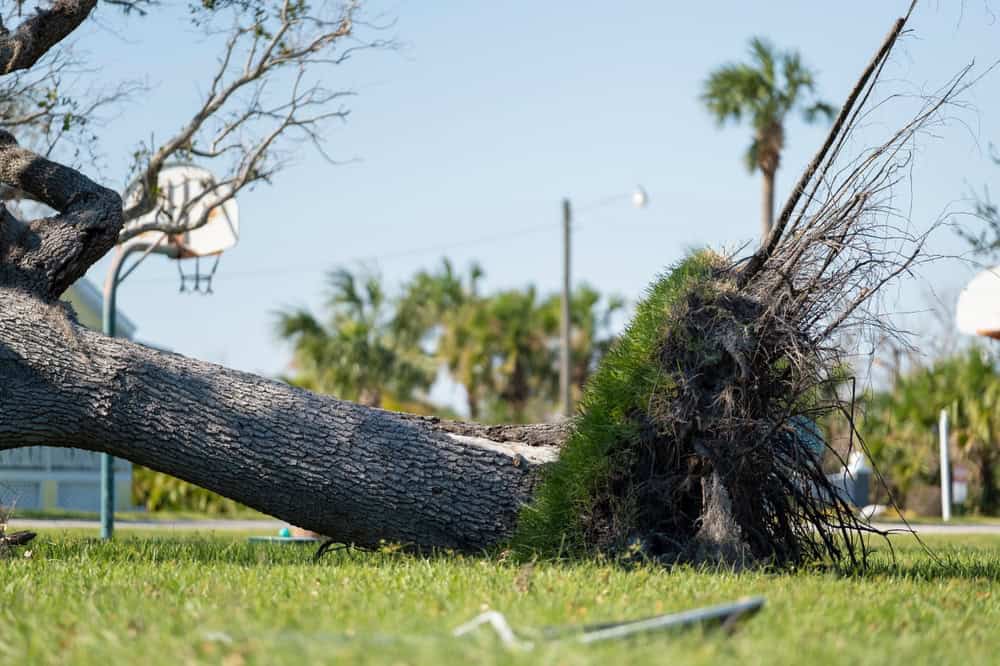
Partially uprooted trees are deceptively dangerous. They look stable until they’re not. The compromised root system and shifted weight distribution create unpredictable failure patterns. Professional arborists use specialized equipment to stabilize these situations before systematic removal begins, preventing sudden collapse that could injure people or damage property.
We’ve seen how Long Island’s coastal conditions—salt air, high winds, and saturated soils—create unique tree stress that accelerates damage. Our 15 years serving Suffolk County means we recognize warning signs that homeowners and out-of-area contractors miss completely.
What to Do Immediately After Storm Damage
You’re looking at damage, and your next moves matter for both safety and insurance purposes. Work through this systematically, even though you’re stressed and want the mess gone.
Start with a safety check from a distance. Don’t approach any trees until you’ve confirmed there are no downed power lines in or near them. Assume any wire on the ground is live and stay at least 25 feet away. Call 911 to report downed lines before doing anything else.
Once you’ve confirmed the area is safe, document everything before touching anything. Your insurance company needs proof of what happened and what was damaged. This documentation often determines whether your claim gets approved or denied.
How to Document Storm Damage for Insurance Claims
Take photos and videos from multiple angles before any cleanup begins. Capture the tree, the damage it caused, and the surrounding area. If a tree fell on your roof, photograph the tree itself, the impact point, and any interior damage like water stains or structural cracks. Don’t just shoot the obvious damage—document your entire property because storm debris causes subtle problems that become expensive later.
Get both close-up shots showing specific damage details and wide shots establishing context. The combination proves the tree’s size, position, and the scope of damage. If you have photos of your property before the storm, gather those too. They help establish what was damaged versus what was pre-existing.
Here’s what most Suffolk County homeowners don’t know about tree removal coverage: your insurance typically caps it at $500 to $1,000 per tree, and only covers removal when trees damage covered structures or block essential access. If the tree just fell in your yard without hitting anything, removal probably isn’t covered. Your policy covers the damage the tree caused, not the inconvenience of having a tree down.
This matters because your deductible might be $1,000 or more. If removal only costs $600 and your tree didn’t damage anything, filing a claim makes no financial sense. You’d pay the full cost anyway, plus the claim goes on your record and could affect your rates. Understanding this before you call your insurance company helps you make informed decisions.
Contact your insurance provider as soon as possible after documenting damage. Don’t wait days or weeks—prompt reporting is usually required by policy terms. Ask specifically about your tree removal coverage limits, your deductible, and what documentation they need. Get a claim number and your adjuster’s name. Many insurance companies require storm-damaged roofs to be tarped because once water gets in, mold remediation costs thousands of dollars and your claim could be denied if they determine you didn’t take reasonable steps to prevent it.
Avoiding Storm Chasers and Finding Legitimate Help
After major storms hit Suffolk County, unlicensed contractors start knocking on doors in affected neighborhoods. They offer immediate service, pressure quick decisions, and often demand cash or large upfront payments. Some do subpar work. Others take your money and disappear. These storm chasers cause as much damage as they prevent.
Legitimate emergency tree services don’t pressure you into immediate decisions or demand full payment before starting work. They provide written estimates, proof of insurance, and references. They understand you’re stressed and need help, but they also respect that you need to make informed choices about who’s working on your property.
Verify that any tree service carries comprehensive liability insurance and workers’ compensation coverage. Tree removal is dangerous work involving heavy equipment, chainsaws, and unpredictable loads. Without proper insurance, you could be held personally liable if someone gets hurt on your property. Ask to see current certificates of insurance before any work begins, and actually verify them—don’t just take their word for it.
Licensed arborists bring specialized knowledge that matters for storm damaged tree removal. They assess whether trees can be saved or need removal, identify hidden damage creating ongoing hazards, and use proper techniques preventing additional property damage during removal operations. This expertise matters more in Suffolk County because coastal conditions create specific challenges that generic tree services don’t understand.
Get at least two or three estimates if time allows, but don’t let comparison shopping delay addressing immediate safety hazards. If a tree is on your house or creating active danger, safety trumps finding the lowest bid. For less urgent situations, comparing estimates ensures you’re getting fair pricing and appropriate scope of work.
Watch for these red flags: contractors showing up unsolicited immediately after storms, anyone asking for full payment before starting work, companies that can’t provide proof of insurance, or services pressuring you to sign contracts on the spot without time to review. Legitimate companies understand homeowners need to verify credentials and check references.
We’ve served Suffolk County for 15 years with licensed arborists, full insurance coverage, and transparent pricing. Our local reputation is built on responsive service, thorough cleanup, and fair treatment during stressful situations—not on showing up at doors after storms and pressuring quick decisions.
Protecting Your Property When Coastal Storms Strike
Storm-damaged trees create immediate safety concerns and potential for multiplying property damage with every hour of delay. Knowing when situations demand emergency response, how to document damage properly, and what your insurance actually covers makes the difference between manageable cleanup and costly disaster.
Suffolk County’s position on Long Island’s coast means you’re dealing with nor’easters, high winds, and saturated soils that stress trees in ways most homeowners don’t recognize until it’s too late. Professional assessment catches hidden damage before it becomes an emergency. Prevention through regular maintenance costs less than emergency response, but when storms hit, you need experienced help fast.
If you’re dealing with fallen trees, blocked access, or potentially unstable trees after storm damage, we provide 24/7 emergency response throughout Suffolk County, NY. Our team of licensed arborists brings local expertise, proper equipment, and 15 years of experience handling exactly these situations.