
Summary:
Most homeowners don’t think about their trees until something forces them to — a branch comes down in a storm, a trunk starts leaning toward the house, or a neighbor says something. By then, the situation is usually more serious than it needed to be. The good news is that trees give off warning signs well before things get dangerous. You just need to know what you’re looking at. If you’re a homeowner in Suffolk County or Nassau County, this is worth a few minutes of your time — especially heading into another Long Island storm season.
What Your Trees Are Actually Telling You — and Why It Matters on Long Island
Long Island’s weather doesn’t go easy on trees. Nor’easters, tropical storms, summer thunderstorms with sudden wind gusts — Suffolk County and Nassau County homeowners deal with all of it, year after year. That kind of repeated stress takes a toll on trees, and the damage isn’t always visible from the outside.
What makes this tricky is that a tree can look perfectly healthy from your kitchen window while quietly developing internal decay, root problems, or structural weaknesses that make it genuinely dangerous. That’s not meant to alarm you — it’s just the reality of owning property with mature trees on it. The earlier you catch a problem, the more options you have. Wait too long, and your choices narrow down fast.
Dead or Hanging Branches: The Warning Sign Most Homeowners Underestimate
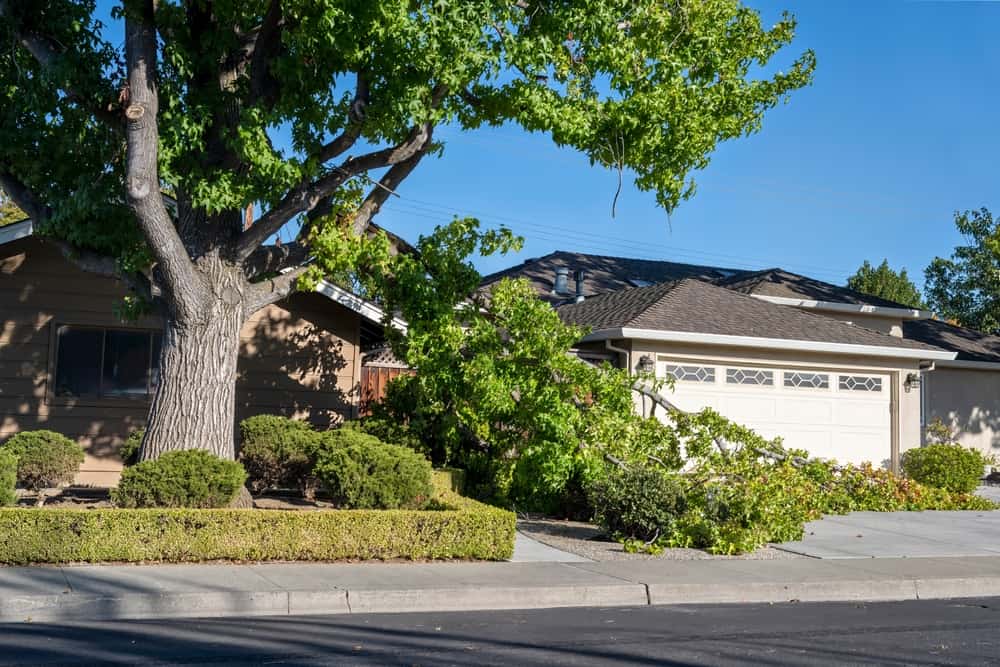
Dead branches are probably the most common sign people notice — and the most commonly ignored. It’s easy to write off a dead limb as just part of having an older tree. But dead branches don’t stay put. They dry out, become brittle, and eventually come down. The question is whether they come down in a controlled removal or during a storm, onto your roof, your car, or someone in your yard.
In Suffolk County specifically, the risk window is real. A single nor’easter can turn a dead branch you’ve been meaning to deal with into a genuine emergency. And if that branch is hanging over your deck, your driveway, or close to a neighbor’s fence line, the consequences go beyond property damage — they become a liability issue.
What you’re looking for: branches that have no leaves during the growing season, bark that’s peeling or falling away, or limbs that look visibly dry and brittle compared to the surrounding canopy. You might also notice small piles of sawdust-like material at the base of a tree, which can indicate insect activity — something we’re seeing more of on Long Island as the Emerald Ash Borer continues to spread and Oak Wilt has been confirmed in towns including Islip, Riverhead, and Southold.
A dead branch doesn’t always mean the whole tree needs to come down. In many cases, targeted trimming or pruning by a certified arborist is all it takes. But you do need someone who can tell the difference — and who knows which cuts actually help the tree versus which ones create new problems.
Leaning Trunks, Lifted Roots, and Other Structural Red Flags to Watch For
A tree that wasn’t leaning before and now is — that’s a problem. It sounds obvious, but a lot of homeowners assume a slight lean is just the tree growing toward the light. Sometimes it is. More often, especially after a storm or a particularly wet season, it means the root system has been compromised and the tree is starting to shift.
Lifted or exposed roots are another sign worth paying attention to. If you’re seeing roots that were previously underground starting to heave out of the soil on one side of the tree, that’s the ground telling you something. It usually means the root structure on the opposite side is weakening, which affects the entire tree’s stability.
In Nassau County, Bradford pear trees are especially common in older neighborhoods and along street plantings — and they’re notorious for forming weak branch unions that look fine until a heavy snow load or wind event causes them to split right down the middle. If you have a Bradford pear and you can see bark folding inward where two major branches meet, that’s not cosmetic. That’s a structural failure waiting to happen.
What you’re also watching for: cracks or splits in the main trunk, fungal growth like mushrooms or conks at the base of the tree (which almost always signals internal decay), and any signs of soil movement or mounding around the root zone. None of these things fix themselves. And with a median property value of over $578,000 in Suffolk County, the cost of ignoring a structurally compromised tree can be steep — in more ways than one.
When to Call a Tree Removal Company vs. When to Wait
Not every tree problem requires removal. That’s worth saying plainly, because some homeowners assume that calling us means they’re going to lose the tree. That’s not usually how it works. We look for ways to save a tree before recommending removal — through pruning, cabling, or treatment depending on what’s going on.
That said, there are situations where removal is the right call, and waiting only makes it riskier and more expensive. Knowing the difference matters, and it’s not always something you can assess from the ground on your own.
Do I Need a Permit to Remove a Tree in Suffolk County, NY?
This is one of the most common questions we hear from homeowners across Suffolk County, and the honest answer is: it depends on where you live and what tree you’re dealing with. Many municipalities in Suffolk County require permits for the removal of trees above a certain diameter, trees classified as protected species, or trees located near wetlands or coastal areas. Given that Suffolk County has nearly 1,000 miles of shoreline, a significant number of properties fall into that category.
The permit process varies by town. What’s required in Huntington isn’t necessarily the same as what’s required in Babylon or Smithtown. Some towns have additional protections for specific native species — Red Oak and American Beech, for example, are common throughout the county and may be subject to local preservation rules depending on where your property sits.
This is one area where hiring a local tree service with real experience in Suffolk County pays off. We know the permit landscape across the towns we serve, and we can tell you upfront whether your job is going to require one — saving you from fines or delays that catch homeowners off guard when they try to handle removal on their own or hire someone who doesn’t know the local rules.
The short version: don’t assume you can remove a large or protected tree without checking first. And if you’re not sure, a free assessment from one of our certified arborists is the fastest way to get a clear answer.
How Do I Know If I'm Hiring a Legitimate Tree Service or Getting Scammed?
After a major storm on Long Island, the calls start coming in — and unfortunately, so do the door-to-door contractors. Some are legitimate. Many are not. It’s a pattern that the Better Business Bureau and district attorneys’ offices across New York have warned about repeatedly, and Suffolk County and Nassau County homeowners are not immune to it.
The warning signs of an unlicensed or unqualified tree company are pretty consistent: they show up unsolicited after a storm, they offer a price that seems almost too good, they’re vague about insurance, and they want cash upfront. The problem with hiring someone like that isn’t just the quality of the work — it’s the liability. If an uninsured worker is injured on your property during a tree job, you could be the one responsible for those costs.
Here’s what a legitimate tree service should be able to show you without hesitation: proof of general liability insurance, proof of workers’ compensation coverage, and credentials showing we have ISA Certified Arborists on staff. ISA certification isn’t a marketing badge — it requires passing a comprehensive exam covering tree biology, diagnosis, and safety, plus a minimum of three years of hands-on field experience. It’s the standard the industry uses to separate professionals from people who just own a chainsaw.
We also recommend getting a written, itemized quote before any work begins. Not a ballpark, not a handshake agreement — a written quote that spells out exactly what’s being done and what it costs. Any reputable tree company will provide this without being asked.
What to Do Next If You're Concerned About Your Trees
If you’ve been reading this and a specific tree — or a specific branch — has been in the back of your mind the whole time, that’s worth acting on. Most of the calls we get from homeowners in Suffolk County and Nassau County follow the same pattern: they noticed something months ago, kept meaning to deal with it, and then a storm made the decision for them.
The five signs covered here — dead or hanging branches, structural lean or lifted roots, signs of disease or pest activity, fungal growth at the base, and visible trunk damage — don’t resolve on their own. They either stay the same or they get worse.
Getting an assessment doesn’t lock you into anything. It just gives you real information about what you’re dealing with so you can make a smart decision. We’ve been working with homeowners across Suffolk County for 15 years, and our team of certified arborists is available around the clock — including for emergency situations after storms. If something in your yard is giving you pause, reach out to us. We’ll tell you exactly what we see.