Summary:
A storm rolls through Suffolk County, and by morning there’s a tree leaning hard toward your house. Or a branch the size of a compact car is hanging over your car by what looks like a thread of bark. You’re not sure if it’s an emergency or if you’re overreacting — and you definitely don’t know whether you need a permit before anyone can touch it.
These are the exact questions we hear from homeowners across Suffolk County every week. This page answers them directly, so when something goes wrong — at 2 AM or on a Sunday afternoon — you know what to do and who to call.
Emergency Tree Service Response in Suffolk County
Not every tree problem is an emergency, but some absolutely are — and the difference matters. A tree that has partially uprooted, a trunk that has split down the middle, or a large limb resting against a power line are situations where waiting even a few hours can mean the difference between a manageable removal and a collapsed roof.
True emergency tree service means someone answers the phone at any hour, assesses the situation quickly, and gets a crew out before the damage compounds. That’s what 24/7 availability actually means — not a voicemail promising a callback when the office opens Monday morning.
What Counts as a Tree Emergency — and What Can Wait
This is the question most homeowners struggle with, and it’s worth being direct about. Some tree situations are urgent. Others look alarming but can safely wait a day or two for a scheduled appointment.
Call for emergency tree service immediately if you’re dealing with a tree or large limb that has fallen onto your home, fence, or vehicle. The same applies if a tree is leaning more than roughly 15 degrees toward a structure — that’s the threshold at which arborists consider collapse risk to be imminent, not theoretical. Visible root plate lifting, where the ground around the base of the tree is heaving or cracking, is another sign the tree is already failing. A split trunk with a widening gap is similarly urgent.
The situation that catches a lot of homeowners off guard is the partially uprooted tree that looks stable. It’s still standing, the canopy looks fine, and nothing has fallen yet. But a tree in that condition has already lost the root system integrity it needs to stay upright. It can come down during calm weather — not just during the next storm — because the remaining roots are under far more stress than normal. If you see a tree that moved during a storm and then settled back into an upright position, don’t assume it’s okay. Get it looked at the same day.
On the other hand, a dead branch that hasn’t fallen yet, a tree that needs pruning, or a stump you want removed after a previous job — those are real needs, but they don’t require an emergency call. A standard appointment handles those just fine, and scheduling in advance usually means better pricing and more flexibility on timing.
When in doubt, call and describe what you’re seeing. A few minutes on the phone with someone who knows trees can tell you whether you’re dealing with a same-day situation or something that can wait for the week.
How Emergency Tree Removal Actually Works — From the First Call to Final Cleanup
Understanding the process takes a lot of the anxiety out of an already stressful situation. Here’s what happens from the moment you call to the moment our crew packs up and leaves.
The first step is assessment. Before any cutting starts, a trained arborist evaluates the tree — its lean, the condition of the root system, whether the trunk or major limbs are under tension, what’s in the drop zone, and whether utility lines are involved. This isn’t a formality. It’s what separates a controlled removal from a dangerous one. Cutting a tree that’s leaning against a structure, or one with a partially broken limb under tension, without understanding the physics of how it will move is how serious injuries happen.
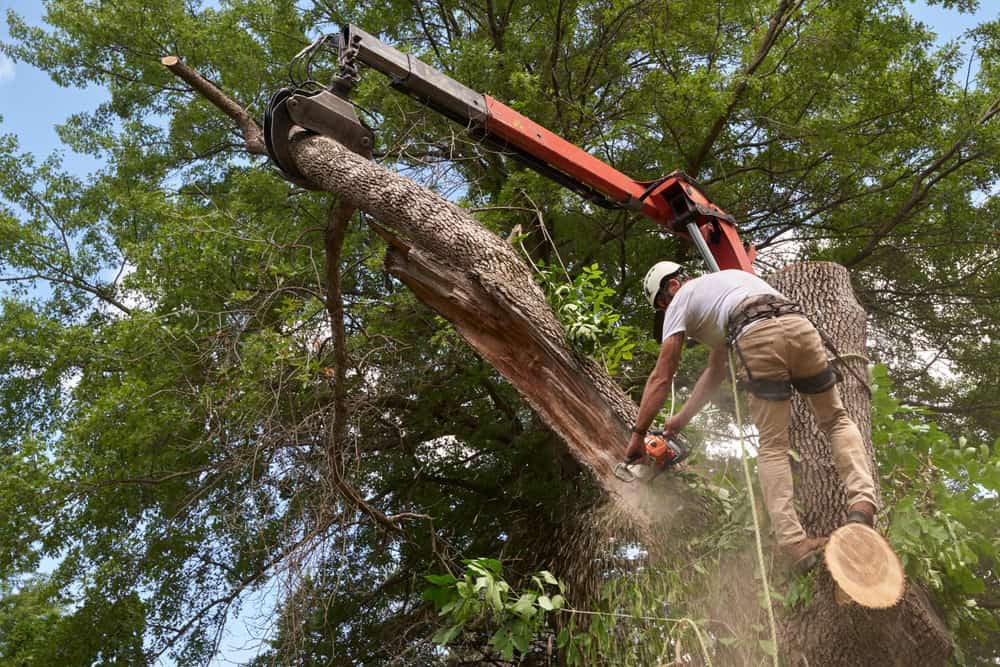
Once the assessment is done and a plan is in place, our crew works systematically. Large limbs are rigged and lowered rather than dropped freely when there are structures, vehicles, or tight spaces below. The right equipment matters here — a bucket truck or aerial lift for height, proper rigging for controlled descent, and chippers or hauling equipment to handle the debris. Not every tree service has this equipment on hand. We do, which means we can handle emergencies that others can’t.
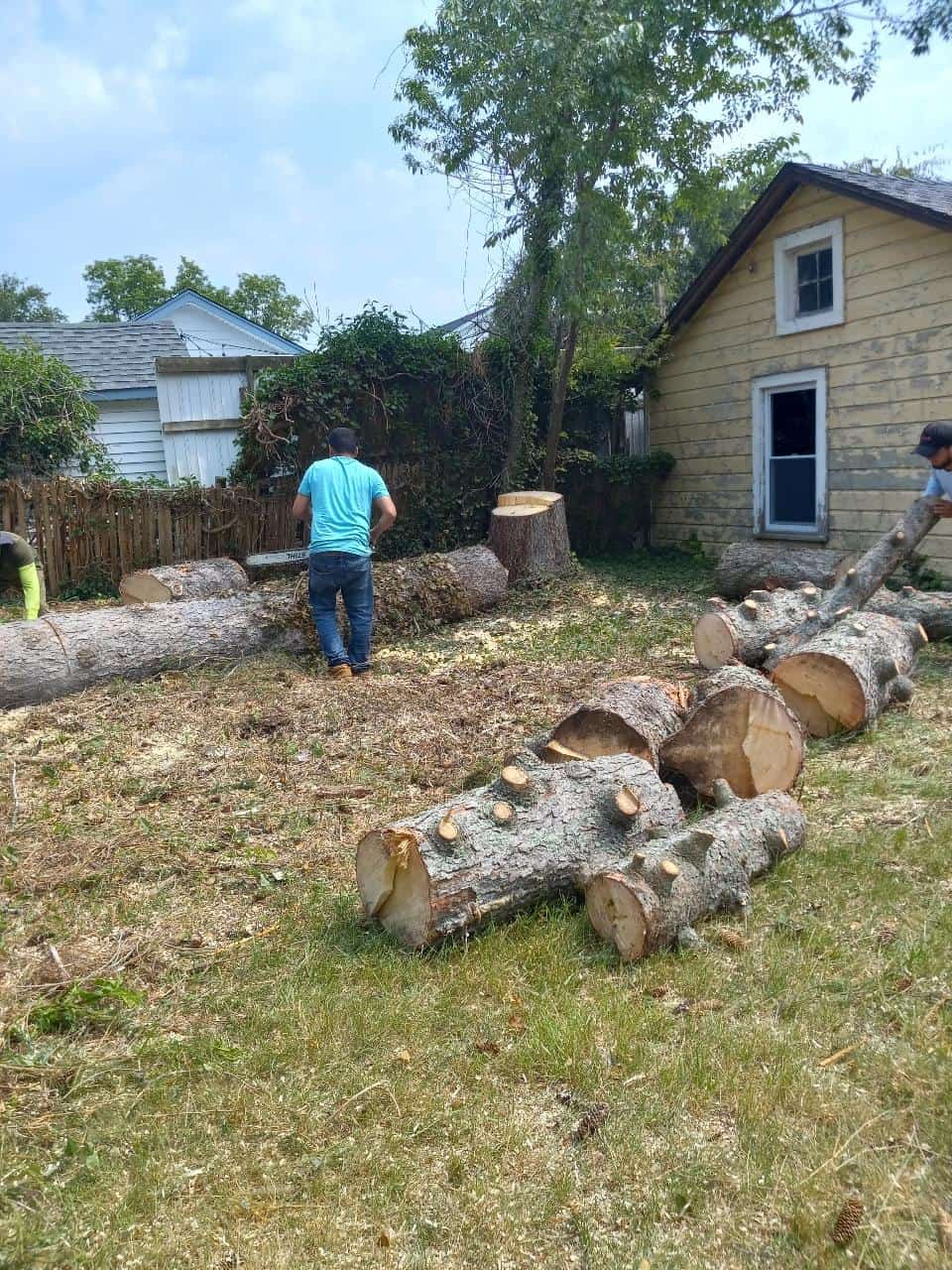
Cleanup is part of the job, not an afterthought. Every branch, log, and wood chip gets removed from the property before we leave. Suffolk County homeowners who’ve used our services consistently mention this — the yard is left clean, not just cleared of the immediate hazard.
One more thing worth knowing: if your tree has damaged a structure, document everything before any work begins. Photos of the tree’s position, the point of contact with the structure, and any visible damage to your home or property are valuable for your insurance claim. We can help with that documentation as part of the job.
Tree Removal Permits for Emergency Situations in Suffolk County
This is one of the most common reasons homeowners hesitate to call — they’ve heard that tree removal requires a permit in Suffolk County, and they don’t want to do something illegal or get stuck in a bureaucratic process while a dangerous tree is threatening their home.
Here’s the reality: yes, many municipalities in Suffolk County do require permits for tree removal. But emergency situations are treated differently, and understanding how that works removes a major barrier to getting help quickly.
Do You Need a Permit for Emergency Tree Removal in Suffolk County?
Suffolk County is made up of ten towns — Babylon, Brookhaven, East Hampton, Huntington, Islip, Riverhead, Shelter Island, Smithtown, Southampton, and Southold — and each one has its own tree ordinance. Permit requirements, tree size thresholds, and the specific rules around protected species vary by municipality. What’s required in Smithtown isn’t necessarily the same as what’s required in Southampton.
That said, virtually every municipality in Suffolk County has provisions for emergency tree removal. When a tree poses an imminent safety hazard — to a structure, a person, or a utility line — most local codes allow the work to proceed immediately without waiting for a permit to be issued. The typical requirement is that the homeowner or contractor files for the permit after the fact, within a defined window that usually ranges from 10 to 30 days depending on the town.
What this means practically is that you don’t need to figure out the permit situation before calling for help. If a tree is actively dangerous, the priority is removing the hazard. The paperwork follows.
We navigate this process regularly across all of Suffolk County. We know which towns require post-work filings, what documentation is needed, and how to handle the administrative side so you’re not left dealing with it on your own after an already stressful event. For homeowners in places like Port Jefferson Station, Nesconset, East Shoreham, or Southampton, the permit rules differ in the details — and having a local crew that already knows the landscape, literally and administratively, makes a real difference.
One important note: if the tree you need removed is healthy and not an immediate hazard, the emergency exemption likely doesn’t apply. In that case, getting the permit in advance is the right move. We can walk you through that process too.
Why Suffolk County's Coastal Climate Makes Tree Emergencies More Common Than You'd Expect
Long Island’s geography puts Suffolk County homeowners in a uniquely exposed position. The county sits between Long Island Sound to the north and the Atlantic Ocean to the south, with Great South Bay and Peconic Bay cutting through the middle. That coastal exposure amplifies every storm that comes through — nor’easters hit harder here than they do 30 miles inland, and tropical storms that have weakened by the time they reach the mid-Atlantic can still do significant damage on Long Island.
Nor’easters are the biggest recurring threat. The heavy, wet snow they drop on Suffolk County’s mature oak and maple canopy is extraordinarily destructive. A large white oak with a full canopy can hold thousands of pounds of wet snow — far more than its branch structure was designed to bear. Ice storms are worse. A coating of ice adds weight gradually and invisibly, and branches that look fine at 9 PM can be on the ground by midnight.
There’s also a soil factor that most homeowners don’t think about. Long Island’s soil is largely sandy — a legacy of the glacial deposits that formed the island. Sandy soil drains well under normal conditions, but it doesn’t anchor tree root systems the way heavier clay soils do. After a heavy rain, when the ground is saturated, trees that have stood for 50 years can uproot in sustained winds that wouldn’t have moved them in dry conditions. This is why post-storm emergencies in Suffolk County often involve trees that showed no obvious signs of distress before the storm.
Properties near the Sound, the bays, or the Atlantic face an additional layer of stress: chronic salt spray exposure. Salt damages bark, stresses root systems over time, and accelerates internal decay in ways that aren’t visible from the outside. A tree on a property in East Shoreham or Southampton that looks healthy from the street may have significant structural compromise inside. This is part of why a professional assessment matters — especially after any significant coastal storm.
We’ve been doing this work in Suffolk County for over 15 years, through nor’easters, tropical storms, and everything in between. We know how Long Island’s native trees — the white oaks, red oaks, pitch pines, and Norway maples that fill these neighborhoods — respond under stress. That local knowledge isn’t something you get from a company that drives in from out of town after a storm.
Emergency Tree Services Near You — What Suffolk County Homeowners Should Do Next
If you’re reading this after a storm, the most important thing is this: don’t wait to see what happens. A tree that’s leaning, cracked, or partially uprooted isn’t going to get more stable on its own. Getting a professional set of eyes on it quickly — even just a call to describe what you’re seeing — is always the right move.
If it’s a true emergency, we respond 24 hours a day, any day of the year. If it can wait, we’ll tell you that honestly and help you schedule something that makes sense. Either way, you won’t be left guessing.
We’ve been serving Suffolk County homeowners for over 15 years. We’re licensed, insured, and local — and we’ll leave your property clean when the job is done. Give us a call at 631-639-4004.