Summary:
Most people hiring a tree company are thinking about the tree — not the paperwork. That’s completely understandable. But in Suffolk County, where nor’easters roll through every winter and mature oaks can come down without much warning, the insurance question matters more than most homeowners realize.
If a worker gets hurt on your property and the company isn’t properly covered, you may be the one holding the bill. And if they damage your roof or your neighbor’s fence, your own homeowner’s policy might not cover it either — depending on who you hired.
Here’s what you actually need to know before anyone starts cutting.
Tree Service Insurance Coverage Types Every Homeowner Should Understand
There are two types of insurance that matter when you’re hiring a tree company: general liability and workers’ compensation. Both serve different purposes, and having one without the other still leaves you exposed.
General liability covers damage to property — your home, your fence, your neighbor’s yard — and injuries to anyone who isn’t an employee of the company. Workers’ compensation covers the crew members themselves if they’re hurt on the job. Together, they create a complete picture of protection. Separately, there are real gaps.
General Liability Insurance for Tree Service: What It Actually Covers
General liability insurance is what most people picture when they hear “the company is insured.” It covers third-party property damage and bodily injury — meaning if a branch falls and crushes your fence, or a limb swings wrong and breaks a window, the company’s policy handles it rather than yours.
For residential work in Suffolk County, the standard minimum is $1 million per occurrence. Commercial jobs typically require $2 million, and municipal contracts can go higher. Those numbers aren’t arbitrary — tree work is physically demanding, high-stakes work where a single mistake can cause serious damage to expensive property.
Here’s something most homeowners don’t know: standard landscaping insurance often only covers ground-level work up to about 8 to 10 feet off the ground. The moment a climber goes higher than that — which is almost always the case for real tree work — a generic landscaping policy may not apply at all. Tree-specific general liability coverage is a different product, and it’s what any legitimate tree service company should carry.
When we say we’re insured at Miguel’s Tree Service, we mean tree-specific coverage — not a landscaping policy that quietly stops applying the moment someone gets in a harness. That distinction matters, and it’s worth asking about directly when you’re getting quotes from anyone.
Tree Removal Insurance: Why High-Risk Work Requires the Right Coverage
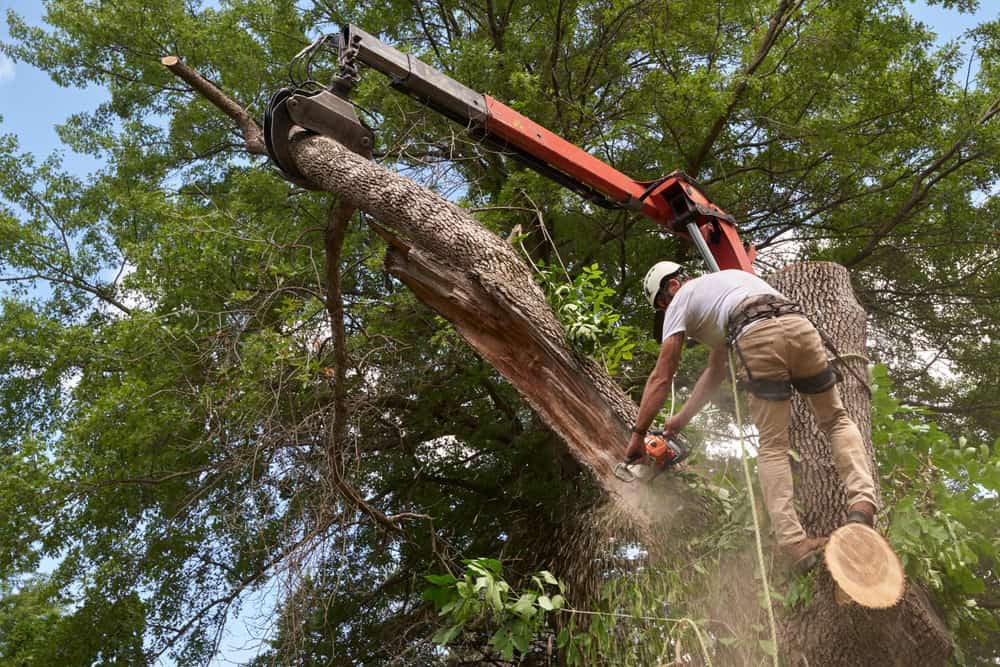
Tree removal is the highest-risk category of tree work, full stop. The Bureau of Labor Statistics puts the fatality rate for tree trimmers and pruners at around 110 per 100,000 workers — roughly 30 times higher than the average across all industries. These aren’t numbers meant to alarm you; they’re context for why the insurance conversation is serious.
When a crew is removing a large oak in Huntington or taking down a storm-damaged pine in Brookhaven, the stakes are real. A tree removal job that goes wrong can injure workers, damage structures, and create liability exposure that lingers long after the job is done. The insurance coverage required for that kind of work needs to reflect the actual risk involved.
Workers’ compensation is the piece of this that most homeowners overlook. General liability covers your property and third parties — but it does not cover the workers themselves. Workers’ comp is a separate policy, and in New York State, it’s legally required for any business with employees. It’s not optional, and it’s not a formality. If a tree worker is hurt on your property and the company doesn’t carry workers’ comp, you as the property owner can be held liable for their medical bills, lost wages, and rehabilitation costs.
That’s a real financial exposure, and it catches people off guard. The homeowner who hired someone because they were a few hundred dollars cheaper on the quote ends up far worse off when something goes wrong. We carry workers’ compensation because it’s the right thing to do — for our crew and for the homeowners who trust us to work on their properties.
How to Verify Tree Service Insurance Coverage Before Work Begins in Suffolk County
Asking “are you insured?” is a start, but it’s not enough. The honest answer you need isn’t a yes or no — it’s a document. A Certificate of Insurance, or COI, is the standard proof of coverage in the industry. It lists the policy numbers, the coverage types, the limits, the effective dates, and the insurance carrier.
We’ll hand you a COI without hesitation. If a contractor gets defensive or vague when you ask for one, that tells you something important. It’s not a rude request — it’s a normal part of hiring a professional for high-risk work on your property.
What to Look for on a Tree Company's Certificate of Insurance
When you receive a COI, you’re looking for a few specific things. First, confirm that both general liability and workers’ compensation are listed as separate line items. A policy that only shows general liability is incomplete — workers’ comp needs to be there too, listed explicitly.
Second, check the coverage limits. For residential tree work in Suffolk County, you want to see at least $1 million per occurrence on the general liability side. Third, check the effective dates. An expired policy is worthless, and some contractors will hand over an old certificate hoping you won’t notice.
Finally — and this is the step most people skip — call the insurance carrier directly using the number printed on the certificate. Don’t use a number the contractor gives you separately. Verify that the policy is active, that the coverage applies to tree work specifically, and that the limits are current. Fake or altered certificates do exist in this industry. It sounds extreme, but the BBB has ranked tree service among the most complained-about industries in the country, largely because of uninsured and unlicensed operators cutting corners.
One more thing worth understanding: some companies use subcontractors rather than direct employees. Subcontractors may not be covered under the company’s main policy, which creates a gap even when the company itself is insured. We work with a direct employee-based team — everyone on your property is covered under our policy, not left in an ambiguous middle ground.
Why Suffolk County Homeowners Face Specific Insurance Risks Other Markets Don't
Suffolk County has a particular combination of factors that makes the insurance question more consequential than it might be elsewhere. The coastal climate means real storm exposure — nor’easters from November through March, tropical systems in late summer, and summer microbursts that can drop a 60-foot oak onto a roof with almost no warning. Emergency tree calls spike after every major storm, and that’s exactly when homeowners are most likely to hire quickly without vetting properly.
There’s also a local policy detail that many Suffolk County homeowners aren’t aware of: a number of homeowner insurance policies in Nassau and Suffolk Counties specifically exclude coverage when unlicensed or uninsured contractors are used. That means if you hire an uninsured tree company and they damage your property, your own insurance may deny the claim entirely. You’d be left paying out of pocket for repairs to your own home — not because of anything you did wrong, but because of who you hired.
New York State law requires businesses with employees to carry workers’ compensation insurance. It’s not a best practice or a recommendation — it’s the law. A company operating without it is operating illegally, and that legal exposure transfers directly to you as the property owner when something goes wrong on your land.
We’ve been working in Suffolk County for over 15 years, serving homeowners in Port Jefferson, Southampton, Smithtown, Babylon, Islip, and communities across the county. We understand what the trees here look like — the mature oaks in Huntington, the wind-exposed pines along the South Shore, the old maples in established neighborhoods throughout Brookhaven. We also understand the permitting requirements, the HOA rules in certain communities, and the specific risks that come with Long Island’s coastal environment. That local knowledge matters, and so does the fact that we carry the right coverage for all of it.
Hiring an Insured Tree Service in Suffolk County: What to Do Before the Next Storm
The best time to vet a tree company is before you need one urgently. When a storm rolls through and a tree comes down on your fence at 10 PM, you’re going to call whoever picks up — and that’s not the moment to be figuring out whether they carry workers’ comp.
What you’ve read here gives you a real framework: know the two types of coverage that matter, ask for the COI before work starts, verify it directly with the carrier, and understand that your own homeowner’s policy may not protect you if you hire the wrong company.
If you’re looking for a tree service in Suffolk County that carries proper insurance, has a direct employee-based team, and has been doing this work locally for over 15 years, we’re ready to answer your questions — including the insurance ones. Reach out for a free estimate and ask us for our Certificate of Insurance. We’ll send it without hesitation.