Summary:
You’ve probably walked past it a dozen times. Maybe you noticed it looked a little off last spring — thinner than the trees around it, fewer leaves, some bark that seemed to be pulling away. You told yourself you’d get a better look later.
Later has a way of becoming November, and November in Suffolk County means nor’easters. If a tree on your property is dead or dying, the time to deal with it is now — before the ground freezes, before emergency rates kick in, and before the wind makes that decision for you. Here’s what to look for.
How to Tell If a Tree Is Dead or Just Dormant
This is the question most homeowners get stuck on, and it’s a reasonable one. In late fall, every deciduous tree looks bare. The difference between a dormant tree and a dead one isn’t always obvious from the sidewalk.
The most reliable field test is the scratch test. Find a small twig or a section of younger bark and scratch the surface lightly with your fingernail or a pocket knife. A living tree will show a thin green layer just beneath the outer bark — that’s the cambium, and it means the tree still has vascular activity. A dead tree will show dry, brown, or tan tissue with no green at all.
Do this in several spots across different branches. One dead branch doesn’t mean the whole tree is gone, but if you’re getting brown tissue everywhere you check, that tree isn’t coming back.
Signs a Dying Tree Is Past the Point of Saving
A dying tree is different from a dead one — it still has some living tissue, but it’s declining and unlikely to recover without intervention. Knowing the difference matters because some trees can be treated, while others need to come down before they become a hazard.
Crown dieback is one of the clearest signs. This is when death progresses from the top of the canopy downward — the upper branches go bare first, then the dieback creeps lower over successive seasons. If you look up at a tree in mid-summer and the top third has no leaves while the lower canopy still does, that’s crown dieback, and it usually signals something serious happening at the root level or in the vascular system.
Bark that is peeling, sloughing off in large sheets, or missing entirely is another red flag. Healthy bark protects a tree’s inner tissue. When it starts falling away without any mechanical cause — no storm damage, no equipment contact — it typically means the cambium beneath has died and the tree is no longer sustaining that outer layer.
You may also notice large sections of the trunk that sound hollow when knocked. Internal decay doesn’t always show on the surface, but a hollow sound is a strong indicator that structural integrity is already compromised.
Fungal growth at the base of a tree — mushrooms, shelf fungi, or bracket fungi growing directly from the root flare or lower trunk — is a serious warning sign. These fungi feed on decaying wood. Their presence at ground level means decay is already active inside the tree, often in the root system or lower trunk where you can’t see it. A tree with active fungal decay at its base can look relatively healthy from a distance right up until it fails.
Finally, watch for root plate heaving — soil that looks raised, cracked, or disturbed around the base of the tree on the side opposite a lean. This means the root system is losing its grip. A tree in this condition can topple with surprisingly little wind.
Tree Disease in Suffolk County: What's Actually Killing Local Trees Right Now
Tree disease is an umbrella term, but in Suffolk County, there are a few specific threats worth knowing about — because they’re actively killing trees across the region right now, and many homeowners don’t recognize what they’re looking at.
The Emerald Ash Borer was confirmed in Suffolk County in 2019 by Cornell Cooperative Extension. Since it arrived in North America in 2002, this invasive beetle has killed hundreds of millions of ash trees. Ash is a common street and landscape tree throughout the county, and EAB kills them from the inside out. The larvae feed on the tissue just beneath the bark, cutting off the tree’s ability to move water and nutrients.
By the time you can see the D-shaped exit holes in the bark from the ground, the tree has typically been infested for multiple generations and is already severely compromised structurally. Yellowing or thinning in the upper canopy is usually the first visible sign — if your ash tree looks sparse up top, get it looked at.
The Southern Pine Beetle is a second invasive pest that has become widespread in Suffolk County in recent years. It’s devastating pitch pines — the signature tree of Long Island’s Pine Barrens. If you’ve driven through the central part of the county and noticed clusters of dead, rust-colored pines along the roadside, that’s what you’re looking at. Pitch pines in decline show thinning crowns, yellowing needles, and resin flow at beetle entry points.
Oak Wilt is a fungal disease confirmed in Islip, Riverhead, and Southold. Red oaks are particularly vulnerable and can die within a single season once infected. The telltale sign is leaves turning brown and dropping in summer — not fall — starting from the outer edges of the canopy inward. Homeowners often mistake this for drought stress, which delays response and gives the disease time to spread.
If you have ash trees, pitch pines, or red oaks on your property and any of them look off, don’t wait for a second opinion. These are active, confirmed threats in Suffolk County, not theoretical ones.
Why Dead Tree Removal Before Winter Matters More in Suffolk County
Suffolk County has received 13 federal disaster declarations since 2000. Sandy, Irene, Ida — these aren’t distant memories for most homeowners here. The county sits between the Atlantic Ocean and the Long Island Sound, which means it catches coastal storms from multiple directions, and nor’easters can arrive as early as December with sustained gusts over 60 mph.
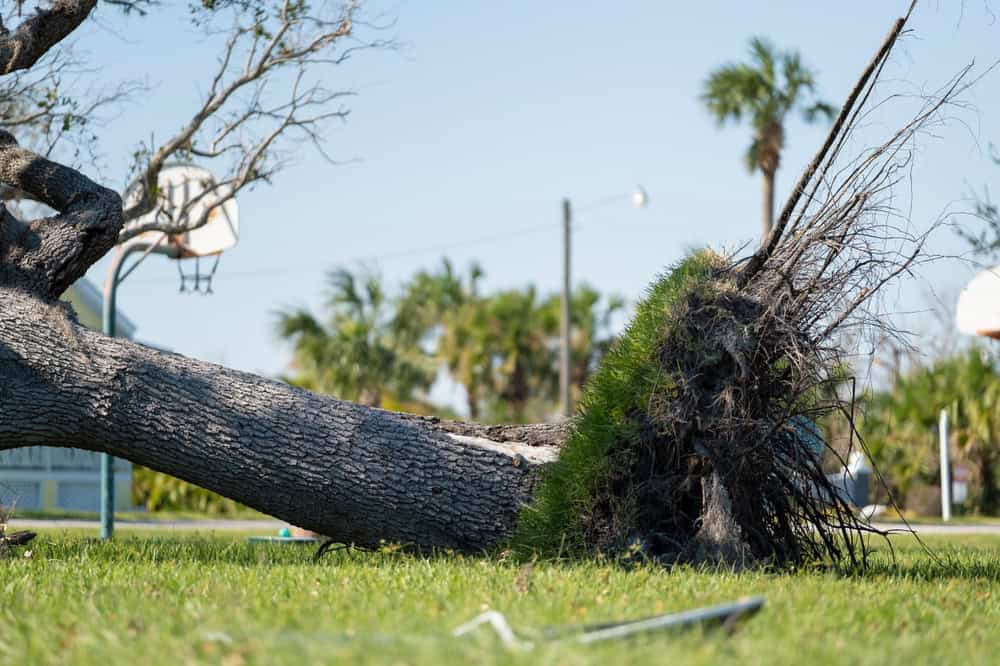
A dead tree has no root moisture uptake. Its wood is brittle, its branches are dry, and it has lost the hydraulic pressure that keeps a living tree flexible under wind load. Add to that the fact that Long Island’s soils are predominantly sandy glacial outwash — which provides shallower root anchorage than clay-heavy inland soils — and a dead tree in Suffolk County is genuinely more susceptible to toppling than the same species in most other parts of New York.
Does Homeowners Insurance Cover a Dead Tree That Falls?
This is probably the most important question on this page, and the answer surprises a lot of people.
Homeowners insurance generally does not cover damage caused by a dead tree that you knew about and left standing. Multiple major insurers — including Progressive, Nationwide, and GEICO — have confirmed that if a tree was clearly neglected, dead, rotting, or posing a known hazard, the insurer may deny coverage for the resulting damage. The standard homeowners policy covers sudden, unexpected events. A dead tree falling is not unexpected if you were aware of its condition.
In some cases, insurers can request documentation that a known hazard was addressed as a condition of continued coverage. The average bodily injury and property damage claim runs into the tens of thousands of dollars. Emergency tree removal after a fall costs 50 to 100 percent more than a planned removal scheduled in advance.
So the math is straightforward: proactive dead tree removal is almost always the cheaper outcome, even before you factor in the possibility of a denied insurance claim.
There’s a related liability issue worth understanding as well. If you have a dead tree on your property and it falls onto a neighbor’s structure, your neighbor may have grounds to pursue your homeowners insurance — or you personally — for the damage, particularly if they had previously made you aware of the hazard. This is a real legal exposure, not a hypothetical one. It connects directly to how neighbor tree disputes play out in Suffolk County, and it’s one more reason why a known dead tree is a financial and legal liability, not just a safety concern.
If you’re not sure whether a tree qualifies as a known hazard, that’s exactly what a professional assessment is for.
Ash Borer Treatment: When Removal Is the Only Option
Not every ash tree infested with the Emerald Ash Borer needs to come down. That’s worth saying clearly, because some homeowners assume EAB is an automatic death sentence for their trees. It isn’t — if it’s caught early enough.
Trunk injections of systemic insecticides are the primary treatment option for EAB-infested ash trees. When applied before the infestation has progressed too far, these treatments can protect a tree for roughly two years before retreatment is needed. Cornell Cooperative Extension and the New York State DEC both provide guidance on treatment options and timing.
If your ash tree still has a reasonably full canopy and the dieback is limited to the upper portion, it may be a candidate for treatment. A qualified arborist can assess whether the tree’s structure is still sound enough to justify the investment.
The problem is that many homeowners don’t notice EAB damage until the tree is already too far gone. Once the infestation has progressed through multiple generations — which is typically when the D-shaped exit holes become visible from the ground — the tree’s vascular system is severely compromised. At that point, the tree isn’t just dying; it’s also becoming structurally unpredictable. Dead ash trees become brittle relatively quickly, and their branch wood can fail without much warning.
If you have an ash tree on your Suffolk County property and you’re not sure where it stands, the right move is to have it assessed before winter. If treatment is still viable, you’ll want to know that now, not in the spring after another season of decline. If removal is the right call, getting it done before the ground freezes and before nor’easter season begins is both safer and less expensive than waiting.
We’ve handled EAB-affected ash trees across Suffolk County, and the ones that come down cleanly are always the ones scheduled ahead of time — not after a storm has already made the decision.
When to Call for Dead Tree Removal in Suffolk County
If your tree fails the scratch test in multiple places, shows crown dieback, has bark peeling away without cause, or sits over a structure in sandy Long Island soil — that’s not a wait-and-see situation. The pre-winter window is real, and it closes faster than most homeowners expect.
The good news is that a professional assessment takes the guesswork out of it entirely. You don’t have to be certain the tree is dead to make the call. You just have to be uncertain enough that it’s worth knowing for sure before a nor’easter settles the question for you.
We’ve been working in Suffolk County for 15 years. We’re locally based in Port Jefferson Station, we’re available for consultations the same or next day, and we handle everything from the assessment through the cleanup. If you’ve got a tree you’re not sure about, reach out to us before the season changes.