
Summary:
You’ve been staring at those branches for two seasons now. They hang over your roof, drop debris in your gutters, and every time a nor’easter rolls through, you hold your breath. The tree technically belongs to your neighbor — or maybe it’s right on the line — and you’re not sure what you’re allowed to do, who pays, or whether touching it without asking is going to start a whole thing.
You’re not alone. On Long Island, where lots in Nassau County can run 40 feet wide and Suffolk County properties spread across everything from dense neighborhoods to wooded estates, mature oaks spread 30 feet in every direction. Here’s what you actually need to know.
What New York Law Actually Says About Trees on the Property Line
New York law gives you more control over this situation than most homeowners realize. If your neighbor’s tree has branches hanging over your property, you have the legal right to trim them back to the property line — without asking for permission first. That’s established under New York case law, and it applies whether you’re in Suffolk County or Nassau County.
The key word is “trim.” You can cut what crosses onto your side. What you can’t do is damage the tree to the point where it harms the overall health or structural integrity of the whole thing. That’s where liability starts to shift. A clean, professional cut at the property line is protected. A hack job that kills the tree is not.
Who Owns a Tree That Sits Directly on the Property Line?
This is the question that trips people up the most, and the answer matters before you call anyone. If the trunk of the tree sits squarely on the property line — not leaning one way, not mostly on one side, but actually straddling the line — then both you and your neighbor are considered co-owners under New York law. Neither of you can remove it without the other’s agreement.
That sounds frustrating, but in practice it usually isn’t. Most neighbors, once they understand the situation clearly, are willing to have a conversation — especially when a professional has already assessed the tree and explained the risk. What makes these conversations go sideways is when one party acts unilaterally, damages the tree, or removes it without notice. That’s when you end up in small claims court instead of just splitting the removal cost.
If the trunk is mostly on your neighbor’s property but branches cross onto yours, the tree belongs to them. You can still trim your side. But if you want the whole tree removed — because it’s dead, leaning dangerously, or dropping limbs on your garage — you’ll need their cooperation, or at least a documented conversation showing you tried to get it.
One practical step that protects you legally and keeps the relationship intact: send a written notice to your neighbor before any work begins. It doesn’t need to be formal or threatening. A simple note explaining what you’re planning, why, and when goes a long way. If they object, you have documentation that you tried. If they don’t respond, you have documentation of that too. Either way, you’re covered.
This is something we walk customers through regularly. The legal side of a property line tree job is often the part people are most anxious about — and once it’s explained clearly, most of the anxiety goes away.
If a Neighbor's Tree Falls on Your Property, Who Pays in NY?
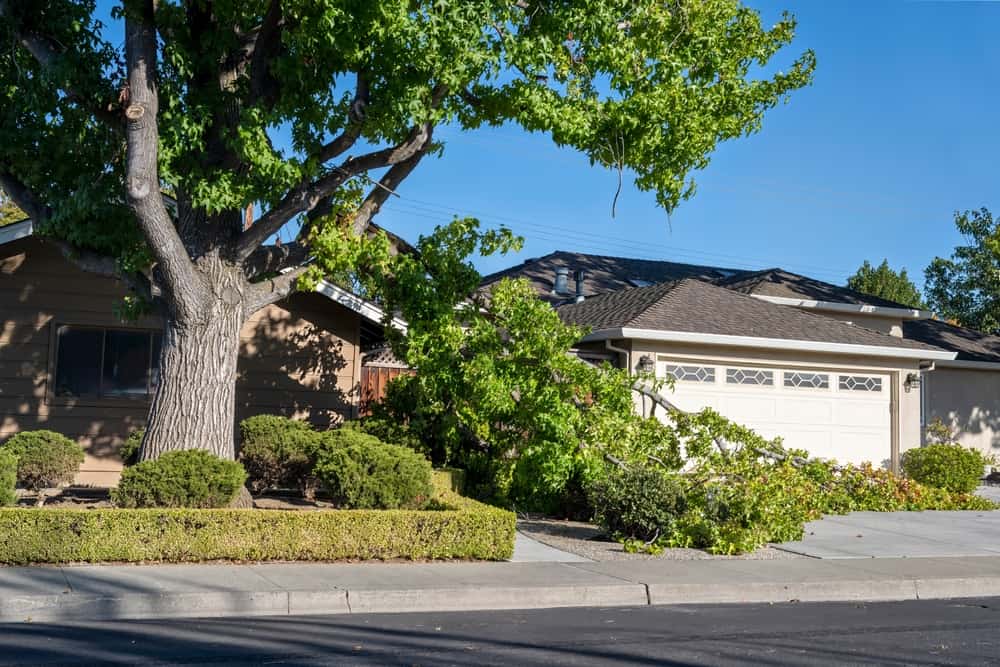
This one surprises a lot of people. In New York, if a tree falls due to a storm — a nor’easter, a tropical remnant, a summer microburst — the general rule is that each property owner deals with the damage on their own side. Your neighbor’s insurance doesn’t automatically cover the limb that crushed your fence. You file with your own homeowner’s insurance.
That changes if you can show negligence. If the tree was visibly dead, rotting, or leaning dangerously, and you notified your neighbor in writing that it posed a risk, and they failed to act — that’s where a negligence argument starts to take shape. The documentation matters enormously here. A text message, a dated letter, even a certified arborist’s written assessment that you shared with your neighbor can establish the record you’d need.
Long Island’s storm exposure makes this more than a hypothetical. The nor’easters of 2018, 2021, and 2024 knocked down thousands of trees across Suffolk and Nassau Counties — weakened root systems, hidden decay, bark that looks fine from the street but is hollow underneath. If you have a mature tree near your home that went through any of those storms and was never professionally assessed, that’s worth a phone call before the next one hits.
What a certified arborist can do in this situation is give you a documented health assessment — something that clearly establishes whether the tree poses a risk and what the recommended course of action is. That document protects you. It also gives you something concrete to show a neighbor if you need to have that conversation. “Here’s what the arborist found” lands very differently than “I think your tree looks bad.”
How to Hire a Tree Service in Suffolk or Nassau County Without Getting Burned
The Long Island tree service market is crowded. After any major storm, it gets worse — out-of-town crews show up door to door with cash-only offers and no paperwork, and some homeowners take them up on it. That’s almost always a mistake.
Knowing what to ask before anyone touches a tree on your property protects you from liability, bad work, and unexpected costs. There are a few things that should be non-negotiable, and a few things that separate a professional crew from a cheap one.
What Insurance Should a Tree Service Company Have Before Starting Work?
Ask for a certificate of insurance before you sign anything or shake any hands. Specifically, you want to see two things: general liability insurance and workers’ compensation insurance. Both matter, but workers’ comp is the one most homeowners don’t think about until it’s too late.
Here’s why it matters. If a tree service worker is injured on your property and the company doesn’t carry workers’ compensation, you — the homeowner — can be held personally liable for their medical bills and lost wages. That’s a real financial exposure that has blindsided homeowners across Suffolk and Nassau Counties before, and it will again. Any legitimate tree company will hand you a certificate of insurance without hesitation. If we get vague, change the subject, or say “don’t worry about it,” walk away.
General liability covers damage to your property during the job. If a limb swings the wrong way and takes out a section of your fence or cracks a window, you want that covered by the tree service’s policy — not yours. A company that carries proper coverage is also a company that has thought seriously about risk, which usually means they’ve thought seriously about how they do the work.
In Suffolk County and Nassau County, the density of residential neighborhoods makes this especially important. On a narrow lot in Merrick or a wooded property in Lloyd Harbor, there’s not a lot of margin for error. Equipment, crew, neighboring structures — everything is closer together than it would be in a rural setting. That’s not a reason to avoid the work. It’s a reason to make sure the people doing it are properly covered and know what they’re doing.
Do You Need a Permit to Remove a Tree in Suffolk County or Nassau County?
The honest answer is: it depends on your town, and the rules change more often than most homeowners expect. Suffolk County doesn’t have a single countywide tree removal ordinance. Instead, each township sets its own rules — and the Town of Huntington, the Town of Islip, the Town of Brookhaven, and the Town of Southampton all have different requirements around permit thresholds, tree diameter minimums, and protected species.
Nassau County municipalities, particularly incorporated villages, tend to be even more specific. Many have tree preservation ordinances that apply to trees above a certain caliper size, trees in certain zones near wetlands or conservation areas, or trees on corner lots and streetscapes. Garden City, Great Neck, and Oyster Bay-area communities are among those with active enforcement. Getting this wrong can mean fines, mandatory replanting requirements, or being ordered to stop work mid-job.
This is one of the most common sources of frustration for homeowners who try to manage tree removal on their own. They get a quote, schedule the work, and then find out two days before that a permit was required — or worse, they find out after the tree is already down. We work regularly in Suffolk and Nassau Counties and know which towns require permits, what the thresholds are, and how to file before the job starts. That’s not a small thing. It’s the kind of local knowledge that saves you time, money, and a very unpleasant conversation with your town’s code enforcement office.
We handle permit coordination as part of the job. If a permit is needed for work on your property, we identify that upfront and take care of it — so there are no surprises on either end.
Finding a Tree Service on Long Island You Can Actually Trust
Most of the anxiety around property line trees comes from not knowing the rules. Once you understand what New York law allows, what your neighbor’s actual obligations are, and what a legitimate tree service looks like, the whole situation becomes much more manageable.
You have the right to trim what crosses your line. You have the right to protect your property. And you have every reason to work with a crew that knows the local permit landscape, carries proper insurance, and will leave your yard cleaner than they found it.
If you’re in Suffolk County or Nassau County and you’ve got a tree situation — whether it’s a neighbor dispute, a storm-damaged limb, a dead tree you’ve been putting off, or something you just want a professional set of eyes on — we offer free consultations with no obligation. Call, describe what you’re dealing with, and we’ll give you a straight answer.