Summary:
A storm just moved through. Maybe you heard a crack in the night, woke up to a branch across the driveway, or you’re staring at a tree that’s leaning in a way it definitely wasn’t before. The next 24 hours matter more than most people realize. Acting too slowly can turn a contained problem into a costly one. Acting too fast — or without the right information — can put you in real danger. This guide is built for Suffolk County homeowners who want a clear, honest picture of what to do, in what order, and why it matters.
Why Suffolk County Trees Fail After Storms
Suffolk County sits in one of the top ten most hurricane-vulnerable areas in the entire United States — and that’s before you factor in nor’easters, which often hit harder than tropical storms because they combine high winds with saturated soil and, in winter, heavy ice loading. The county has seen seven Presidentially Declared Disasters in a seven-year stretch, and over $1.3 billion in federal disaster aid has been distributed to Suffolk County residents as a direct result of storm events.
What makes storm damage to trees in Suffolk County unique is the soil. Sandy soils dominate much of the county — from the wooded mid-island communities like Coram, Ridge, and Middle Island out to the East End. Sandy soil drains well in dry conditions, but it saturates quickly during heavy rain, and saturated soil dramatically reduces the grip a tree’s root system has on the ground. A tree that stood through a dry-summer windstorm can uproot in the same wind speed after a week of fall rain. That pattern plays out across Brookhaven, Smithtown, and Huntington after nearly every significant storm.
The Trees That Look Fine After a Storm Are the Ones That Surprise You
The visible fallen tree — the one across your driveway or on your fence — is actually the easier problem. You can see it. You know it needs to be dealt with.
The more dangerous situation is the tree that’s still standing but shouldn’t be. After a storm, trees can sustain serious structural damage that’s completely invisible from the outside: a root system that’s partially failed, a hairline crack in the trunk at the base, or soil heaved slightly around the root flare, which signals the tree has already begun to shift. The International Society of Arboriculture specifically recommends that after a severe storm, large trees near structures — even those that appear undamaged — should be assessed by a professional.
On Long Island, the trees most likely to behave this way are large oaks and maples, which dominate the mature canopy in North Shore communities like Port Jefferson, Setauket, and Stony Brook. Oaks tend to uproot in saturated soil rather than snap. Maples frequently develop co-dominant stems — two main trunks growing from a single base — which can split apart under wind or ice load even when the individual stems look perfectly healthy. Eastern white pines, common throughout mid-island Suffolk County, are more likely to snap at mid-trunk during high-wind events, and a broken pine can leave a jagged, unstable stub that’s under significant tension.
The majority of emergency tree calls we respond to involve trees that had pre-existing defects — cracks, internal rot, or root damage — that went unnoticed until a storm exposed them. If you have a large tree within striking distance of your house, your car, or any structure on your property, a post-storm assessment is not an overreaction. It’s the responsible call.
What to Do in the First Two Hours After Storm Damage
The first thing to do after a storm is nothing — at least not outside. Before you walk out to assess the damage, look out your windows and identify anything that could make the situation immediately dangerous. Downed power lines are the most critical hazard. If a tree has brought a line down, treat every wire on or near the ground as live until PSEG Long Island confirms otherwise. Do not approach it, do not let children or pets near it, and call 911 if there’s any immediate threat.
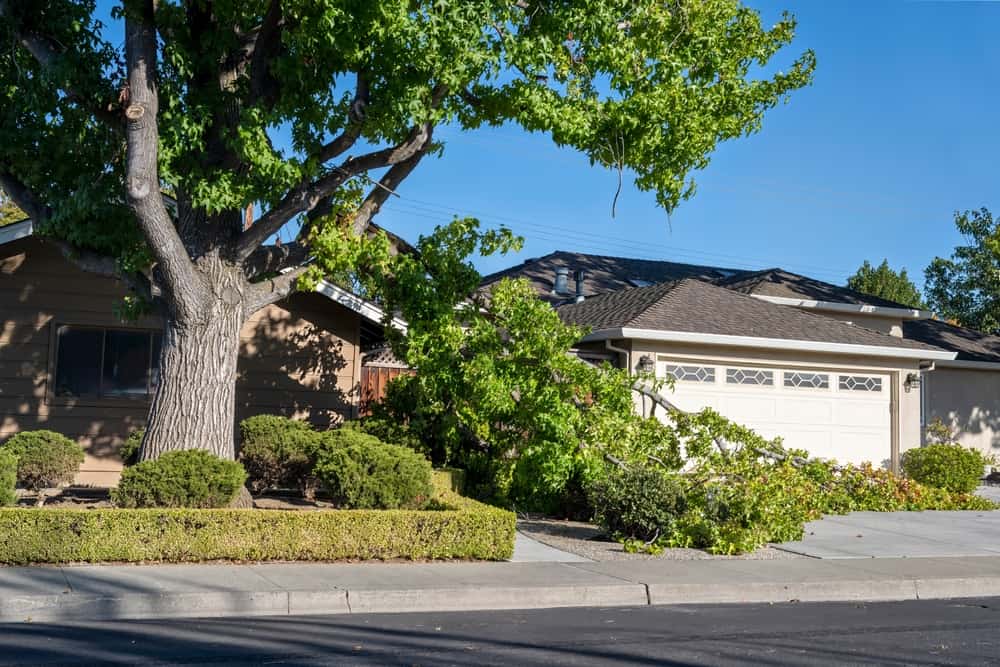
Once you’re confident there’s no live wire situation, you can move outside cautiously to get a better look. What you’re trying to determine in this first pass is whether you have a true emergency — a tree on a structure, a tree blocking a road or exit, a tree visibly leaning toward your house — or a serious but non-urgent situation that needs professional attention within 24 to 48 hours. A tree that has fallen in an open area of your yard, away from any structure, is a cleanup job. A tree that’s partially uprooted and leaning toward your roof is an emergency.
If you see hanging branches overhead — what arborists call widow makers — stay clear of that area entirely. They can fall without any additional wind or disturbance. The same goes for any tree that appears to be resting against another tree or structure; the tension in that kind of situation is unpredictable, and what looks stable can shift suddenly.
Document everything before you touch anything. Take photos and video of all visible damage from multiple angles, including any contact points with structures, fences, or vehicles. This documentation is critical for your insurance claim, and it’s much easier to capture before any cleanup begins. Note the date and time, and if a neighbor’s tree is involved, photograph that clearly as well — including the root ball or trunk origin if the tree has fallen.
Storm Damaged Trees and Your Insurance Claim
Insurance coverage for storm-related tree damage is one of the most misunderstood areas of homeowners policy — and the confusion tends to cost people money. The general rule is this: if a storm-damaged tree falls on a covered structure — your house, a detached garage, a fence — your homeowners insurance typically covers the damage to that structure, including the cost of removing the tree from it. If the tree falls in your yard and doesn’t hit anything, debris removal alone is often not covered.
The neighbor question is where things get particularly murky, and it’s worth understanding clearly before you end up in a dispute.
If Your Neighbor's Tree Fell on Your Property — Who Pays?
This is one of the most common questions we hear after a major storm in Suffolk County, and the answer surprises most people. In the vast majority of cases, your own homeowners insurance covers the damage — even if the tree originated on your neighbor’s property. It doesn’t matter that it was their tree. What matters is that the damage happened to your property, and your policy is what covers your property.
Your neighbor’s insurance only becomes relevant in a specific situation: if their tree was already dead, visibly diseased, or structurally compromised, and you had previously notified them in writing of the hazard, and they failed to act. In that scenario, you may have grounds to pursue their liability coverage. But that’s a narrow set of circumstances, and it requires documentation — your written notice, their non-response, and evidence of the tree’s pre-existing condition. Without that paper trail, the default is your own policy.
This is also why the documentation step matters so much in the first two hours. If there’s any chance the neighbor liability question will come up, you want clear photographic evidence of where the tree came from, what condition the trunk and root system were in, and whether there were any visible signs of decay or disease before the storm. A professional arborist can often identify pre-existing conditions in a post-fall assessment, and a written report from a credentialed arborist carries real weight with insurance adjusters.
Suffolk County homeowners should also be aware that New York State requires tree service companies to carry both general liability insurance and workers’ compensation coverage. If you hire someone who doesn’t have that coverage — especially one of the door-to-door operators who appear in force after every major storm — you can be held personally liable for any injuries that happen on your property during the job. Always ask for proof of insurance before any crew starts work. A legitimate company will have no hesitation providing it.
Finding Emergency Tree Service Near Me After a Suffolk County Storm
After a significant storm hits Suffolk County — whether it’s a nor’easter off Long Island Sound battering the North Shore communities, or a late-season tropical system working up the South Shore — demand for emergency tree service spikes fast. Every legitimate provider in the area gets backlogged quickly, and that’s exactly when less scrupulous operators move in. Storm chasers — unlicensed, uninsured crews who go door-to-door after major weather events — are a real and documented problem on Long Island. They typically offer low upfront quotes, lack proper equipment and training, and if something goes wrong on your property, you may be left holding the liability.
The safest approach is to identify a provider before you need one. If you’re searching for emergency tree service near me in the middle of a post-storm situation, here’s what to verify quickly: Are they licensed and insured, and will they send proof before starting? Do they have verifiable reviews on Google, Angi, or Facebook — not just a website? Do they know who to call at PSEG Long Island if a power line is involved, and will they handle that coordination for you?
That last point matters more than most people realize. Trees near or touching utility lines can’t simply be removed — the process requires coordination with PSEG Long Island, sometimes including a temporary power disconnection, before any crew can safely operate in that zone. A company that doesn’t mention this, or doesn’t know how to navigate it, is a company that hasn’t done this work on Long Island before.
We’ve been serving Suffolk County from our base in Port Jefferson Station for over 15 years. We know the storm patterns here — the nor’easters that roll off Long Island Sound, the way mid-island communities like Coram and Ridge take the brunt of high-wind events, the way a week of October rain sets up the conditions for uprooting even in moderate wind. We carry full liability insurance and workers’ compensation coverage, and we’ll provide proof before we start any job. We also help with insurance documentation, because we know that paperwork is the last thing you want to deal with after a storm.
After the Storm: What Suffolk County Homeowners Should Do Next
The 24-hour window after storm tree damage is when the decisions that matter most get made. Stay away from anything near downed lines. Document the damage before you touch anything. Don’t assume a tree that’s still standing is structurally sound — especially if it’s a large oak or maple within reach of your house. And if a neighbor’s tree is involved, understand that your own insurance is almost always the first call, not your neighbor’s.
If you’re not sure what you’re looking at, that uncertainty is reason enough to have someone come take a look. A professional assessment costs far less than the alternative of a tree coming down on a structure that could have been caught in time. Miguels Tree Service is available 24/7 for emergency situations across Suffolk County — and we’re here for the non-emergency assessments too, because those often matter just as much.