Summary:
You’ve got a tree that needs to come down. Maybe it’s leaning the wrong way, maybe it’s dead, maybe it’s just been bothering you for two summers. You’ve got a chainsaw, a free weekend, and a neighbor who did something similar last fall. So the question isn’t really whether you *could* do it — it’s whether you *should*.
That’s a fair question, and it deserves a straight answer. Not a sales pitch, not a scare tactic — just an honest look at what’s actually involved, what can go wrong, and where the line is between a manageable weekend project and a job that genuinely needs a professional crew.
How to Remove a Tree: What the Process Actually Involves
Tree removal looks simpler from the outside than it is in practice. The general sequence is: assess the tree’s lean, weight distribution, and fall zone; make a directional notch cut on the side you want it to fall; follow with a back cut on the opposite side; and control the descent.
The longer version involves understanding how decay, uneven weight, root damage, and proximity to structures affect every one of those steps. A tree doesn’t always fall where you expect it to. Dead wood is especially unpredictable — internal decay can shift the center of gravity in ways that aren’t visible from the outside.
That’s not a reason to never touch a tree yourself. It is a reason to be honest about which trees are genuinely manageable and which ones aren’t.
When DIY Tree Removal Is Actually Fine
Here’s the honest answer: some trees are perfectly reasonable DIY projects. A small, healthy tree under about 10 to 15 feet tall, standing clear of your house, fence, power lines, and your neighbor’s property, with an open fall zone and no signs of disease or internal decay — that’s a manageable job for a careful homeowner with the right equipment and a basic understanding of what they’re doing.
Low-hanging dead branches that aren’t over a structure are often the same story. If the branch is small enough to handle safely from the ground or a stable ladder, and the risk of it hitting something important is genuinely low, you don’t necessarily need to call anyone.
The key word there is “genuinely.” Homeowners consistently underestimate two things: how much a tree weighs and how little control you have over where it goes once it starts moving. A 20-foot tree can weigh several thousand pounds. The difference between a controlled fall and an uncontrolled one is technique — specifically, the notch cut and back cut combination that directs the fall. Skip that or get it wrong, and the tree decides where it lands.
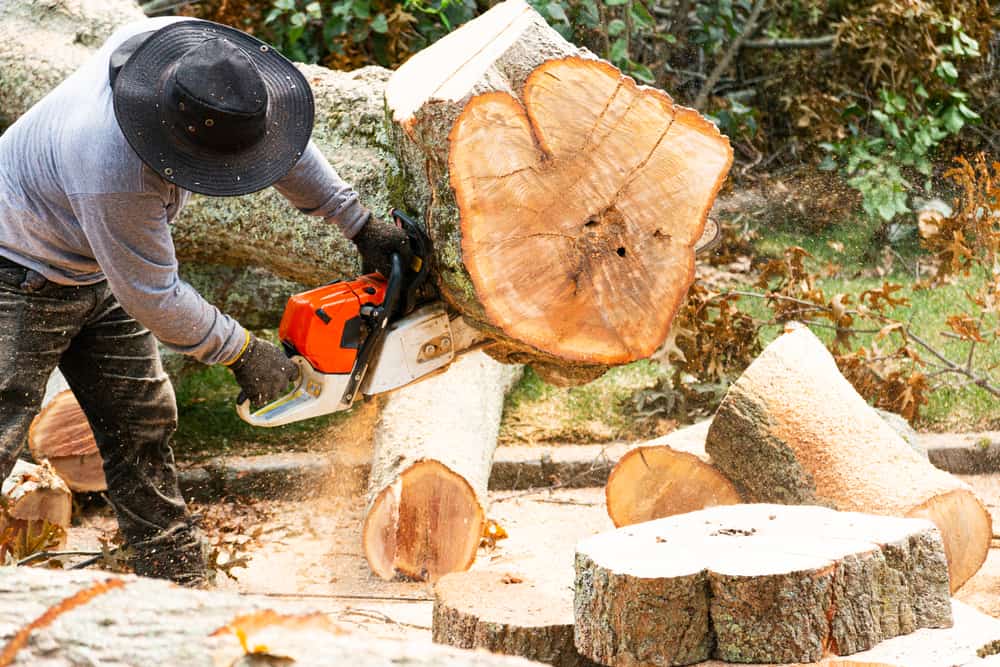
There’s also the equipment side of it. Chainsaws exceed 106 decibels — enough to cause permanent hearing damage in minutes — and the most common serious injury, kickback, happens fast and without warning. According to figures cited by the National Safety Council, seven of the eight most common DIY injuries that land people in the ER can occur while trimming or removing a tree.
So the honest threshold looks something like this: small tree, clear fall zone, healthy wood, no structures or utilities nearby, and you’ve done this before or have taken the time to learn proper technique. If all of those are true, DIY is a reasonable call. If even one of them isn’t, the risk profile changes significantly.
Suffolk County Permit Rules: What Happens If You Skip This Step
This is the part that most online DIY guides completely skip over, because they’re written for a national audience that doesn’t have to worry about it. In Suffolk County, NY, you might.
Many of the townships that make up Suffolk County — including Brookhaven, Huntington, Smithtown, and Islip — have tree ordinances that apply to trees on private residential property. Whether you need a permit depends on the tree’s diameter, its species, its location on your lot, and which township you’re in. The rules aren’t the same across all of them. What’s fine in one town may require a permit in the next.
The permit process for a standard application typically takes 10 to 20 days and costs somewhere between $50 and $200. That’s not a significant burden if you plan ahead. What is significant is the fine for skipping it: unpermitted tree removal in Suffolk County can result in penalties up to $10,000.
There’s also the utility question. If the tree you’re looking at is anywhere near Long Island Power Authority lines, you’re not just dealing with a permit — you’re dealing with a utility coordination requirement that professional crews handle as a matter of routine and that most homeowners don’t know exists. LIPA has its own protocols for trees within striking distance of their lines, and ignoring that isn’t just a regulatory issue, it’s a genuine safety one.
Before you touch a tree in Suffolk County, it’s worth a quick call to your town’s building or code enforcement department to find out whether your specific situation requires a permit. It takes ten minutes and could save you a serious headache. If you’re not sure which township you’re in or what the rules are for your property, we can help you sort that out when we come out for a free estimate.
How to Vet Tree Removal Contractors — and Why It Matters More Than You Think
Here’s the part of this conversation that most homeowners miss entirely: the real decision usually isn’t between DIY and hiring a professional. It’s between hiring a vetted, licensed, insured company and hiring the guy who knocked on your door and offered to do it for $200 cash.
That second option is sometimes called a “chuck in a truck” operator — an unlicensed crew with a pickup, a chainsaw, and no verifiable credentials. They’re common on Long Island, especially after storms when demand spikes and homeowners are stressed and just want the tree gone. The price looks good. The problem is what you don’t see.
Tree Service Liability Insurance: What You're Actually Responsible For
When you hire a contractor to work on your property in New York, you take on more responsibility than most people realize. If a worker is injured on your property and that worker is not covered by workers’ compensation insurance, you may be held liable for their medical costs. This isn’t a hypothetical edge case — it’s a real exposure that the New York State Arborists association specifically warns homeowners about.
There are two types of insurance that matter here and they cover two completely different things. General liability insurance covers damage to your property — if a tree falls on your fence, your car, or your neighbor’s shed. Workers’ compensation insurance covers injuries to the crew members themselves. A legitimate tree service carries both. Many low-bid operators carry neither, or carry one but not the other.
The New York State Arborists association recommends that homeowners not just ask for proof of insurance, but actually call the insurance company directly to verify that the policy is current and active. That’s not paranoia — it’s a reasonable precaution given how often coverage lapses or is misrepresented.
Beyond insurance, there’s the question of credentials. An ISA Certified Arborist has completed a minimum of three years of professional tree care experience and passed a comprehensive exam covering tree biology, structural assessment, pruning, soil conditions, and safety protocols. That credential is verifiable through the International Society of Arboriculture’s website. It’s not the only signal that a contractor knows what they’re doing, but it’s a meaningful one — especially for complex removals involving large trees, proximity to structures, or signs of disease.
On Long Island specifically, this matters because of what’s happening to our trees. Oak wilt, spotted lanternfly, and emerald ash borer are all active threats in Suffolk County. A tree that looks dead or stressed may be structurally compromised in ways that aren’t obvious without training. Sending an untrained crew — or doing it yourself — into a tree that’s been weakened by disease is a different risk profile than a straightforward healthy-tree removal.
What to Look for in a Tree Service in Suffolk County, NY
When you’re evaluating a tree service, a few things separate the companies that are worth hiring from the ones that aren’t. The first is insurance — and as mentioned above, that means both general liability and workers’ compensation, verified, not just claimed. The second is a willingness to come out and assess the job in person before quoting. A phone-only quote for a tree removal is a red flag. The job needs to be seen to be quoted accurately.
Ask whether they pull permits when required. A company that knows Suffolk County’s townships will know when a permit is needed and will handle that process as part of the job. A company that says “you don’t need a permit for that” without checking your specific township’s ordinances is either uninformed or cutting corners.
Look for verifiable reviews — not just a star rating, but named reviewers on platforms like Google, Angi, or Facebook where the review can be traced to a real person. Multi-platform consistency is harder to fake and tells you more than a single-platform rating.
We’re Google Guaranteed, which means Google has verified our licensing and insurance as part of the Local Services Ads approval process. For homeowners who don’t have time to call insurance companies and check credentials manually, it’s a useful shortcut.
One more thing worth mentioning: post-storm demand on Long Island is intense. After Hurricane Sandy, after Irene, after every significant nor’easter, the phones ring constantly and the unlicensed crews multiply overnight. If a tree comes down on your property during a storm, the urgency is real — but it’s also exactly the moment when people make fast decisions they later regret. A company with 24/7 emergency availability and a track record in Suffolk County is worth waiting an extra hour for over a crew you can’t verify.
Making the Right Call for Your Property and Your Peace of Mind
DIY tree removal isn’t always the wrong answer. For the right tree in the right situation, it’s a perfectly reasonable call. But “the right situation” has specific conditions — and in Suffolk County, those conditions include permit requirements, soil characteristics, storm-exposed canopies, and utility line proximity that most general guides don’t account for.
The bigger risk for most Long Island homeowners isn’t doing it themselves. It’s hiring an unlicensed crew without realizing what they’re not carrying — and finding out after something goes wrong.
If you’ve got a tree you’re not sure about, we’re happy to come out, take a look, and give you a straight answer. No pressure, no upsell. Miguels Tree Service has been doing this work in Suffolk County for 15 years, and an honest assessment is always free.