Summary:
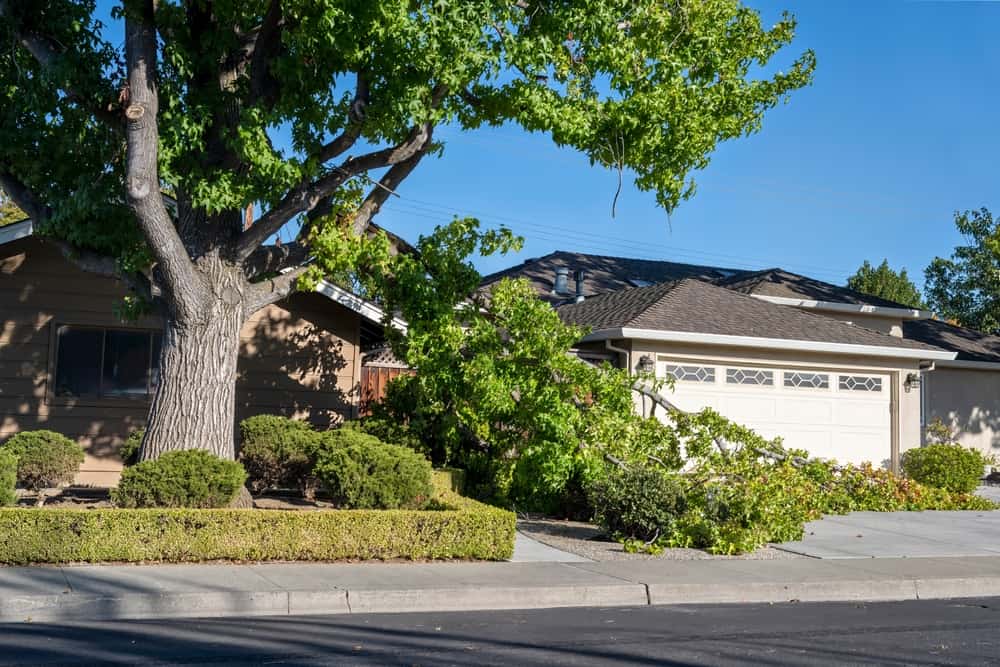
You heard the crack. Maybe it was the middle of the night, maybe it was right as the storm was passing. Either way, you’re standing there now looking at a tree that wasn’t supposed to be where it is — on your roof, across your driveway, or leaning against the fence in a way that makes your stomach drop.
The good news: you don’t have to figure this out alone. The not-so-good news: the next 30 minutes matter, and there’s a specific order to things that most people don’t know until they’re in the middle of it. Here’s what to do.
What to Do Right After Storm Damage: The First 30 Minutes
The biggest mistake homeowners make after a tree comes down is rushing outside to assess the situation before it’s safe to do so. It’s a completely natural impulse — your property, your home, your instinct to go look. But a tree that has partially fallen or is leaning is often more dangerous than one that’s fully on the ground. It’s under tension. It can shift, roll, or drop additional limbs without any warning.
Stay inside or well away from the tree until you know what you’re dealing with. Look from a window first. Check whether any branches are still hanging in the canopy above — arborists call these “widowmakers,” and the name earns itself. Then check for the most urgent hazard of all: power lines.
If a Tree Falls on a Power Line in Suffolk County, Call PSEG Long Island First
This is the detail that most people miss, and it’s the one that matters most for your safety. If a downed tree is touching or near a power line, the entire tree can conduct electricity — the trunk, the branches, even the wet ground around the root ball. You cannot tell by looking at it whether the line is live. Assume it is.
Before you call a tree company, before you call your insurance company, before you do anything else — call PSEG Long Island. They are the utility provider for all of Suffolk County, and they need to de-energize the line before anyone can safely approach the tree. You can reach them at 1-800-490-0075 for emergencies. If there’s any immediate danger to life or the situation feels critical, call 911 first.
Once the power line situation is confirmed safe — or if there are no lines involved — then you move to documentation. This step is more important than most homeowners realize, and it directly affects your insurance claim. Before anyone touches the tree, take photos and video from multiple angles. Get the damage to the tree, any contact with your home or other structures, and the surrounding area. Walk around the perimeter if it’s safe to do so. Your insurance company will want to see the condition of the property before removal began, and if you skip this step, you may have a harder time getting reimbursed.
Once you’ve documented everything, call for emergency tree service. At that point, you also want to notify your homeowner’s insurance company to open a claim — but don’t wait for an adjuster to come out before getting the tree removed if it’s causing active damage or blocking access. Most policies allow emergency removal to proceed, and a reputable tree company can provide documentation to support your claim. One thing worth knowing: most homeowners insurance policies require that removal be handled by a licensed professional. An unverified contractor — or a DIY attempt — can complicate or invalidate your claim.
The last step in your first 30 minutes is simple but critical: don’t hire the first person who knocks on your door. After any significant storm across Suffolk County, unlicensed contractors go door-to-door through neighborhoods offering fast, cheap removal. No written estimate, cash only, pressure to decide right now. If a worker from an uninsured company is injured on your property, you can be held liable. Before anyone touches the tree, confirm they’re licensed, insured, and carrying workers’ compensation coverage.
When Does a Storm-Damaged Tree Need to Come Down — and When Can It Be Saved?
Not every storm-damaged tree needs to be removed. This is a question worth asking before you assume the worst, and it’s one a qualified arborist can answer on-site. The short version: it depends on the extent of the damage, where the damage occurred in the tree’s structure, and the overall health of the tree before the storm hit.
A tree that lost a major limb but has a sound trunk, healthy root system, and no structural compromise may be a strong candidate for professional pruning and crown restoration. Losing a large branch is traumatic for a tree, but it doesn’t automatically mean the tree is a loss. If the damage is limited to the outer canopy and the tree’s core structure is intact, we can remove the damaged material cleanly, help the wound callous properly, and give the tree a real chance of recovery.
On the other hand, removal is typically the right call when the main trunk is split or cracked, when more than half the canopy is gone, when the tree has uprooted at the root ball, or when it’s leaning toward a structure and can’t be safely stabilized. Suffolk County’s sandy, shallow soils — a legacy of Long Island’s glacial geology — mean that trees here are more prone to uprooting than snapping. When a tree comes up at the roots, the structural integrity is gone. That tree is not coming back.
There’s also the question of what the tree was before the storm. A mature oak in Smithtown or a large pine in Brookhaven that was already showing signs of decay, hollow spots, or crown dieback is a different situation than a healthy tree that simply got caught in a bad storm. If you had concerns about a tree before the storm, a post-storm assessment is the right time to get a definitive answer. The cost of removing a compromised tree is almost always less than the cost of emergency removal after it fails on its own.
When we assess a property after a storm, we look at the full picture before recommending anything. The goal is always to save what can be saved — and remove what genuinely needs to go.
What Emergency Tree Service Actually Looks Like When We Arrive
People sometimes assume emergency tree removal is just a faster version of standard removal. It’s not quite that simple. Emergency situations — especially those involving trees on structures, in tight suburban lots, or near utility infrastructure — require a different approach from the moment we pull up.
The first thing we do is assess the full site before anyone picks up a chainsaw. That means evaluating the tree’s position, what it’s in contact with, where the tension is in the wood, and what access we have for equipment. Suffolk County’s densely built neighborhoods — particularly in areas like Huntington, Islip, and western Brookhaven — often don’t allow for straightforward felling. The tree has to come down in sections.
How Downed Tree Removal Works in Dense Suffolk County Neighborhoods
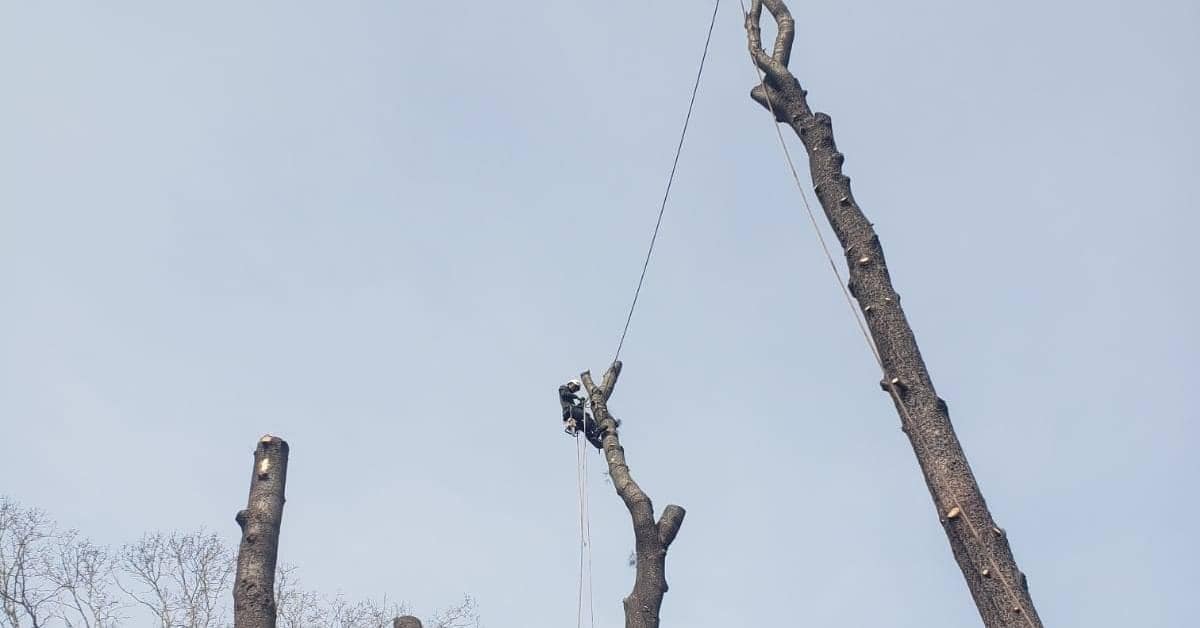
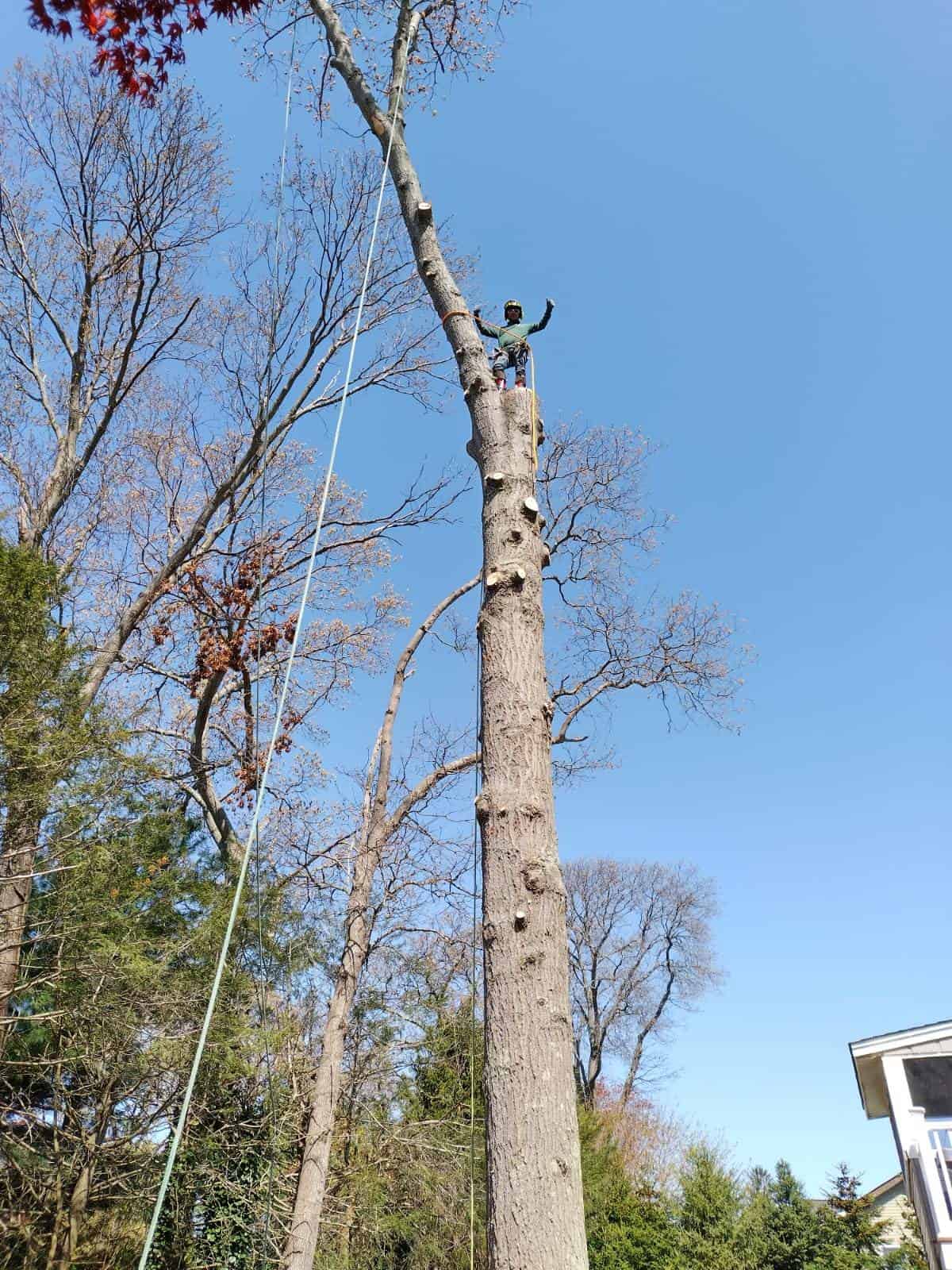
Sectional dismantling is the standard approach for most emergency tree removal in suburban Suffolk County, and it’s more technical than it looks from the street. Rather than cutting the tree at the base and letting it fall — which requires open space and clear sight lines in every direction — sectional removal means working from the top of the tree downward, using rigging systems to control each section’s descent before it’s cut free.
This matters in a neighborhood where your house is 20 feet from your neighbor’s, your driveway is the only access point, and there’s a fence on two sides. Commercial-grade rigging equipment lets us lower heavy sections of wood in a controlled path rather than dropping them, which protects the property and the crew. It takes longer than a simple fell, but it’s the right way to do the job in tight spaces — and most of Suffolk County qualifies as a tight space.
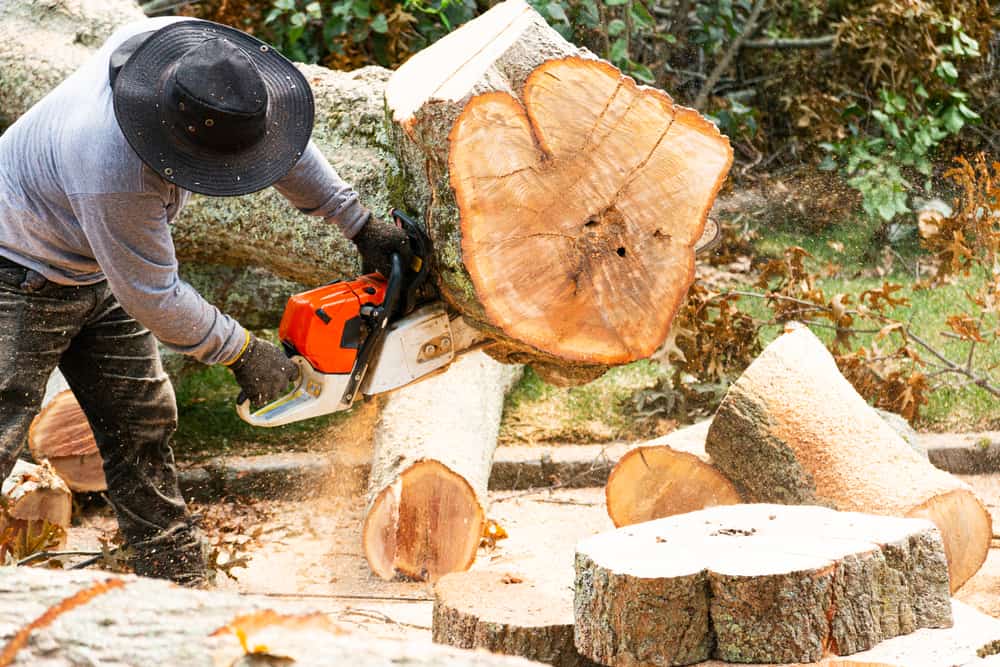
Once the tree is down and sectioned, cleanup is part of the job. That means hauling away all the debris — logs, branches, chips — not leaving it piled at the curb for you to deal with. The price we quote is the price you pay, and debris removal is included. There are no hidden fees for hauling.
If the tree has left a stump, stump grinding can typically be handled at the same time or scheduled as a follow-up, depending on the situation. We’ll walk you through what makes sense for your specific property.
One more thing worth knowing: we can provide detailed documentation of the damage and the removal process to support your insurance claim. That includes written records of what was found, what was removed, and how the work was done. Insurance adjusters want this information, and having it ready from the company that did the work is a lot easier than trying to reconstruct it after the fact.
How to Spot a Storm-Chaser Before They Cost You More Than the Tree Did
After every significant storm on Long Island — whether it’s a nor’easter that came up the coast in February or a fast-moving line of thunderstorms in August — there’s a wave of unlicensed contractors that follows right behind it. They drive through neighborhoods, knock on doors, and offer to take care of the tree today, cheap, cash only. Some of them do the work and disappear. Some take a deposit and don’t come back. And some do the work badly enough that you end up paying a legitimate company to fix what they left.
The red flags are consistent: no written estimate, a demand for cash payment upfront, no local address or verifiable business history, and pressure to make a decision right now before they move on to the next street. Out-of-state plates are common. So is a refusal to provide proof of insurance on the spot.
Here’s why the insurance question matters so much: if a worker is injured on your property and the company doesn’t carry workers’ compensation insurance, that liability can fall on you as the homeowner. It doesn’t matter that you didn’t know they were uninsured. New York State requires tree care companies to carry both liability insurance and workers’ comp, and any legitimate operation will be able to show you proof without hesitation.
The fastest way to verify a company before they start work is to look for Google Guaranteed status. Miguel’s Tree Service is Google Guaranteed — which means Google has independently verified our licensing, insurance, and background before placing that badge on our listing. It’s not a self-reported credential. It’s Google’s own vetting process, and it’s the clearest signal available that the company showing up at your door is the real thing.
Beyond that, look for verifiable local history. We’ve been operating out of Port Jefferson Station for 15 years, serving homeowners and commercial clients across all of Suffolk County — from Huntington and Smithtown to Southampton and Riverhead. Our reviews are on Google, Facebook, and Angie’s List, and they’re from real people in this county. That’s the kind of track record that doesn’t get manufactured overnight after a storm.
When You Need Emergency Tree Removal in Suffolk County, Here's What to Remember
Stay away from the tree until you’ve confirmed there are no power line hazards. Call PSEG Long Island if lines are involved. Document everything before removal starts. Hire a licensed, insured company — and verify it before anyone picks up a chainsaw.
The chaos of the first 30 minutes after a storm feels overwhelming, but the steps are actually straightforward once you know them. The danger comes from skipping them — whether that’s rushing outside before it’s safe, hiring an unverified contractor under pressure, or failing to document damage before it’s cleaned up.
If you’re dealing with a downed tree right now or want to get an assessment scheduled before the next storm season, Miguel’s Tree Service is available 24 hours a day, seven days a week. Give us a call — we’ll come out, take a look, and give you a straight answer about what needs to happen next.