
Summary:
If you’re reading this in late July, you’re not early. You’re right at the edge of the last safe window to get your trees assessed before the Atlantic hurricane season hits its statistical peak in September. Suffolk County homeowners who lived through Superstorm Sandy in 2012 or Hurricane Isaias in 2020 know exactly what’s at stake — and they also know that the week after a storm is the worst possible time to start calling tree services. This guide covers what to look for before the next storm, what to do after one, and how to make sure you’re not the homeowner left with a downed tree on your roof and a two-week wait for help.
How to Tell If a Storm Damaged Tree Is a Real Hazard
The most dangerous trees in Suffolk County don’t always look dangerous. A full, green canopy can hide structural problems that only reveal themselves when 60 mph winds push against it. That’s the part that catches people off guard — the tree looked fine right up until it didn’t.
What you’re looking for from the ground isn’t always obvious, but there are a few things any homeowner can spot without climbing a single branch. The question isn’t whether the tree is alive. It’s whether it can hold together under pressure.
What Are Co-Dominant Stems and Why Do They Fail in Storms?
Co-dominant stems are two or more main trunks growing upward from roughly the same point on a tree, competing for the same space. Instead of one dominant leader with branches growing off it, you’ve got two trunks of similar size pushing against each other as they grow. Over time, bark gets trapped between them — this is called included bark — and that trapped bark prevents the wood from fusing together the way it should. The result is a weak joint that looks solid from the outside but has almost no structural integrity where it counts.
You can often spot this from the ground. Look at where the trunks meet. If the union forms a tight V-shape, that’s a warning sign. A wider U-shape is generally stronger. The V-shaped unions are the ones that split apart in storms — and when they go, they go fast and they go heavy. A mature oak with co-dominant stems can drop half its crown in a single gust.
This is one of the most common failure patterns in Suffolk County’s older residential neighborhoods. The oaks in Port Jefferson, Setauket, and Stony Brook are beautiful trees — many of them 50 to 80 years old — but that age also means they’ve had decades to develop structural issues that weren’t addressed when the trees were young and easier to correct. A certified arborist can assess whether a co-dominant stem situation can be managed with cabling and structural pruning, or whether the risk is too far along and removal is the safer call.
A tree doesn’t have to be dead or obviously diseased to be a hazard. Mushrooms or fungal growth at the base signal root decay. Soft or crumbling bark, cracks in the trunk, or a lean that seems more pronounced than it used to be are all worth a professional look before storm season peaks. None of these are automatic removal sentences — but all of them deserve an honest assessment.
Does Homeowner's Insurance Cover Storm Damaged Tree Removal?
This is one of the most common questions we hear, and the answer is more complicated than most people expect. Generally speaking, homeowner’s insurance will cover damage from a tree that falls on a structure — your roof, your fence, your car under a carport. But coverage gets murkier when it comes to removal costs for a tree that fell in the yard without hitting anything, and it can get outright denied if the insurance company determines the tree was a known hazard that you failed to address.
That last part matters more than most people realize. If you had a visibly dead or diseased tree, and a neighbor or an arborist had flagged it as a problem, and it fell and damaged your neighbor’s property — you may be looking at personal liability rather than an insurance payout. New York property law doesn’t automatically protect you just because the tree was on your side of the line. If you knew the tree was compromised and didn’t act, that’s a different situation than a healthy tree that failed without warning.
This connects directly to why pre-storm tree prep isn’t just about protecting your own house. It’s about protecting yourself from a situation where your neglected tree becomes your neighbor’s problem — and your financial responsibility. Getting a professional inspection before storm season and keeping a record of it creates documentation that can matter a great deal if something does go wrong.
Don’t wait for a storm to find out what your policy actually covers. Call your insurer, ask specifically about tree damage and removal, and get your trees looked at before the season peaks. An ounce of documentation is worth considerably more than a pound of cleanup.
Downed Tree Removal: What to Do Right After a Storm
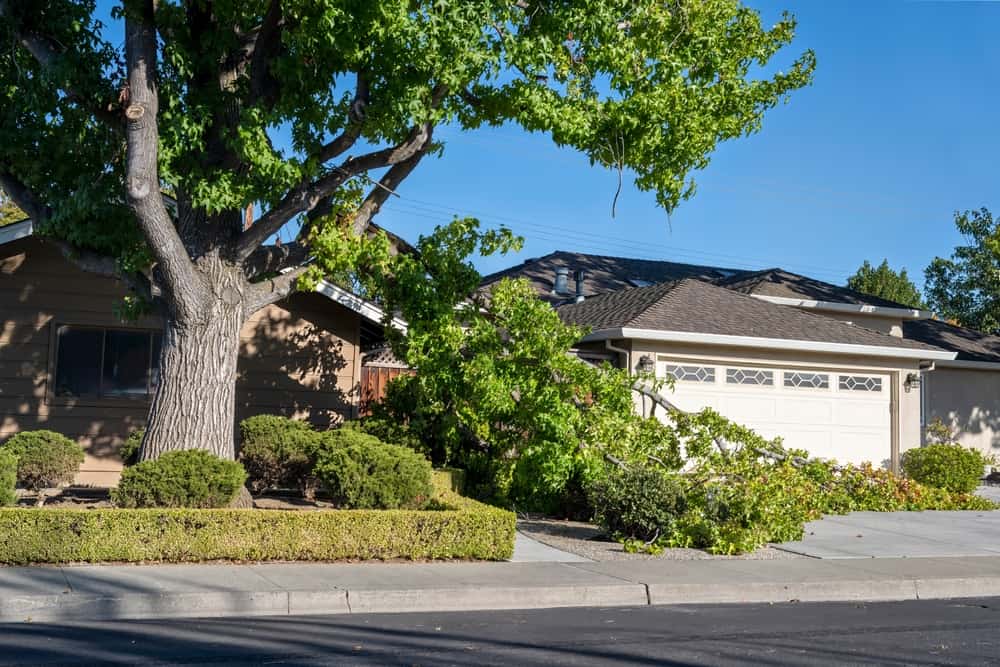
A storm comes through, and in the morning you walk outside to find a tree — or a major section of one — down in your yard, across your driveway, or worse, on your roof. The instinct is to start cleaning up immediately. In most cases, that instinct is right, but there are a few things to check before anyone touches anything.
First: if the tree or any branches are near a power line, stop. Don’t touch the tree, don’t touch anything the tree is touching, and call PSEG Long Island before you call anyone else. A downed line doesn’t have to be sparking to be live and dangerous. This is not a situation for a chainsaw and good intentions.
Storm Damage Tree Service: What the Removal Process Actually Looks Like
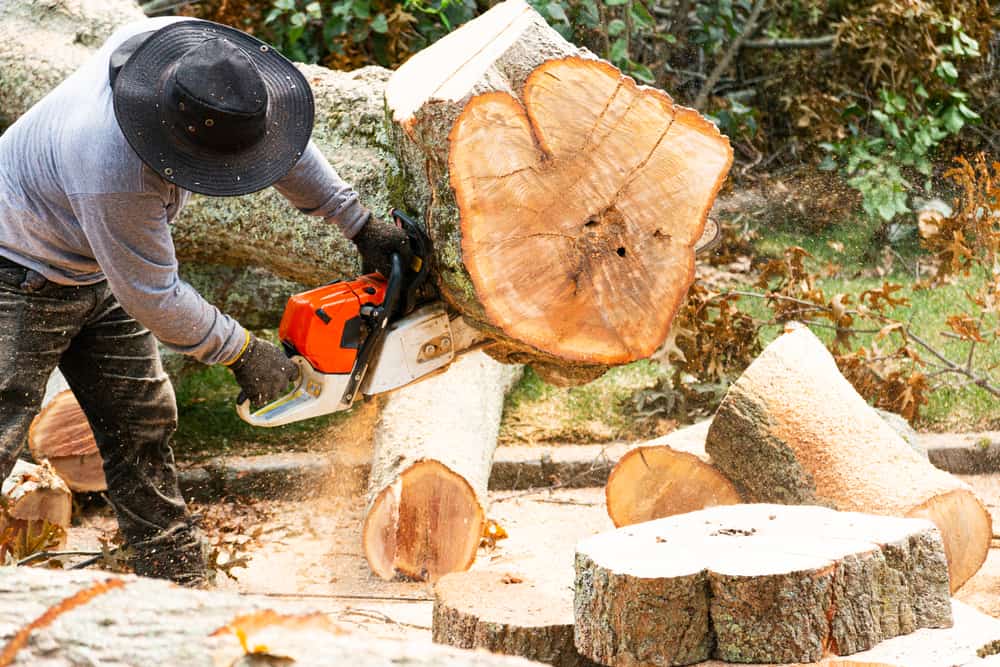
Once a scene is confirmed safe — no live wires, no unstable hanging branches overhead — the removal process depends heavily on what exactly came down and where it landed. A limb in an open yard is a straightforward job. A trunk resting on a roof, or a tree that came down into a tangle of other trees, requires a different approach entirely.
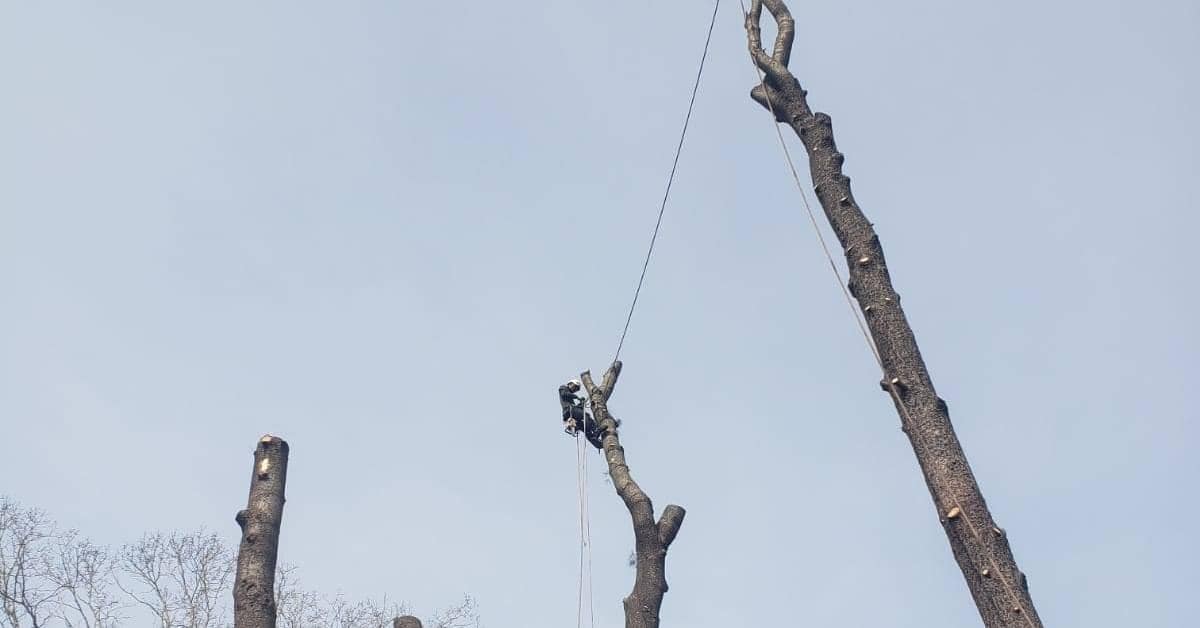
Experienced crews work in sections, not all at once. When a tree is resting on a structure, the weight distribution has to be understood before any cutting starts. Cut the wrong section first and you can shift the load suddenly, causing more damage to the structure or creating a dangerous situation for the crew. This is the kind of work where training and experience aren’t abstract credentials — they’re the difference between a clean removal and a secondary disaster.
After a major storm event in Suffolk County, demand for tree services spikes immediately. After Isaias in 2020, crews across Long Island were booked for weeks. After Sandy in 2012, some areas were still waiting on tree removal when the power restoration crews were wrapping up — and that took more than two weeks in some neighborhoods. The homeowners who had an established relationship with a local tree service, or who had done their pre-storm prep and reduced the number of hazardous trees on their property, were in a much better position than those starting from scratch with a storm-damaged yard and a long list of calls to make.
How to Spot a Legitimate Tree Service After a Storm — and Avoid the Ones You Shouldn't Trust
After every major storm on Long Island, unlicensed crews show up door-to-door offering quick removal at low prices. It happened after Sandy. It happened after Isaias. It’ll happen after the next one. These are often cash-only operations with no insurance, no training, and no accountability if something goes wrong on your property. If a worker gets hurt on your property and the company has no workers’ compensation coverage, you could be on the hook for that too.
The basics of what to ask before anyone starts work: Are you licensed and insured in New York? Can you show proof of general liability and workers’ compensation? How long have you been operating in Suffolk County? A legitimate company answers all of these without hesitation and provides documentation before the job starts.
Beyond the paperwork, there are softer signals worth paying attention to. A company that can explain why a particular tree needs to come down — or why it doesn’t — is a company that actually knows what it’s doing. A crew that defaults to removal for everything, or that pressures you to decide on the spot, is worth a second look. Honest tree assessment sometimes ends with “this tree is fine, here’s what to watch for” — and a company willing to tell you that is one you can trust with the trees that actually do need attention.
We’ve been doing this in Suffolk County for 15 years. We’re Google Guaranteed, licensed, insured, and we’re not going anywhere after the job is done. If you have questions about a tree on your property — whether it’s a pre-storm concern or a post-storm situation — we’ll give you a straight answer about what we’re seeing and what we’d recommend.
When to Call a Tree Service in Suffolk County — Before or After a Storm
The honest answer is: before, if you can. Pre-storm tree prep costs less, takes less time, and gives you control over the situation. Post-storm response is reactive by nature — you’re working around damage that’s already done, in a market where every other homeowner on your street is making the same calls at the same time.
If you’re in Suffolk County and you haven’t had your trees looked at this season, late July is still a workable window — but it’s a narrow one. The statistical peak of Atlantic hurricane season is mid-August through mid-October. That’s not far off, and scheduling fills up fast once the first storm watches start appearing.
Miguels Tree Service is based in Port Jefferson Station and serves homeowners and commercial properties throughout Suffolk County. If you want to get a tree assessed before the season peaks, or if you’re dealing with storm damage right now, reach out and we’ll get someone out to take a look.