Summary:
Most homeowners start the same way — they’ve got a tree that needs to come down, they have no idea what it should cost, and they don’t want to get taken advantage of. So they start searching. What they usually find is a lot of national averages that don’t reflect what things actually cost on Long Island, and a lot of vague advice about “hiring a professional” without any explanation of what that actually means.
We’ve put together this guide to give you real numbers for Suffolk County, broken down by tree size, along with a clear explanation of why the licensing question matters — and how it connects directly to what you’re paying and what you’re protected against.
Small Tree Removal Cost in Suffolk County
Small trees — generally anything under 25 to 30 feet — are the most straightforward removal jobs. Think ornamental trees, young maples, smaller pines, or fruit trees that have outgrown their space. In Suffolk County, removing a tree in this size range typically runs between $290 and $550, depending on accessibility, proximity to structures, and whether stump grinding is included.
At this price point, the job is manageable, the risk is relatively low, and the stakes if something goes sideways are limited. That said, “low risk” doesn’t mean “no risk” — even a 20-foot tree can cause real damage if it falls the wrong way, and cleanup is still part of the job that not every operator handles well.
Pine Tree Removal Cost: What Long Island Homeowners Should Know
Pine trees deserve their own mention because they’re everywhere in Suffolk County — especially in and around the Long Island Pine Barrens, which covers a significant stretch of Brookhaven, Riverhead, and Southampton. Mature pitch pines grow close to residential neighborhoods throughout the county, and they come down for all kinds of reasons: storm damage, root intrusion into foundations or sewer lines, fire risk, or just outgrowing their space next to a structure.
Pine tree removal cost varies more than most species because pines span such a wide range of heights and growth patterns. A medium-sized pine — say, 30 to 50 feet — typically runs $600 to $1,000 to remove in this area. Smaller pines under 25 feet can come in under $550. Taller, older pines that have reached 70 or 80 feet are a different story — those fall into large tree territory and are priced accordingly.
One thing worth knowing about pines specifically: their root systems can be extensive and unpredictable. A tree that looks manageable from the street might have roots that have wrapped around a drainage line or pushed under a concrete slab. We assess the full picture before the saw comes out. A crew that doesn’t might just start cutting and leave you with a problem you didn’t have before.
The other factor that affects pine removal cost is access. Many Suffolk County properties — particularly in wooded areas near the Pine Barrens — have trees that are difficult to reach with standard equipment. Tight lots, overhead lines, and neighboring structures all add complexity. That complexity shows up in the quote, and it should. If a quote for a large pine in a tight space seems unusually low, it’s worth asking how they plan to bring it down safely.
What's Usually Included in a Small Tree Removal Quote — and What Isn't
This is where a lot of homeowners get surprised. The base quote for tree removal often covers the cutting and felling, but stump grinding, debris hauling, and cleanup are sometimes listed as separate line items — or left out of the quote entirely. Before you agree to anything, ask specifically what happens after the tree is down.
We give a written estimate that spells out the full scope: what’s being removed, how the debris is handled, whether the stump is included, and what the site will look like when we leave. That level of clarity isn’t just good practice — it’s one of the clearest signals that you’re dealing with a professional operation rather than someone who showed up with a truck and a chainsaw.
For smaller jobs, the difference between a quote that includes cleanup and one that doesn’t can be $150 to $300. That’s not nothing, but it’s also not the kind of number that should push you toward an operator who can’t tell you what they’re covered for. The real cost of hiring someone uninsured isn’t in the quote — it’s in what happens if a worker gets hurt on your property and there’s no workers’ compensation policy to cover it. At that point, the liability can fall on you as the homeowner.
At the small tree end of the market, the temptation to go with the cheapest option is highest because the job looks simple. But simple jobs go wrong too, and the same licensing and insurance questions apply regardless of tree size.
Cost to Cut Down a Large Tree in Suffolk County
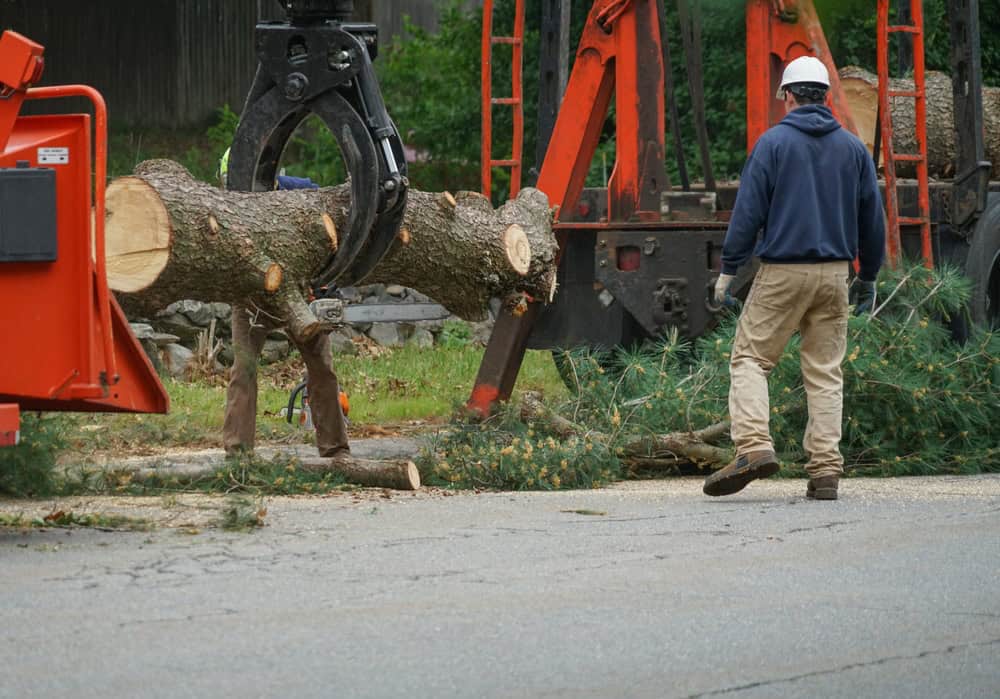
Large tree removal — anything over 50 feet, and especially trees in the 60 to 100-foot range — is where the pricing, the complexity, and the importance of hiring a licensed company all escalate significantly. Suffolk County has no shortage of mature oaks, maples, ashes, and poplars that have been growing for decades and now sit directly over rooflines, driveways, and utility lines.
The average tree removal job in Suffolk County runs about $1,400, with most jobs falling between $500 and $2,300. But large trees push toward the upper end of that range — and sometimes beyond it. A 60 to 80-foot oak typically costs $700 to $1,300 to remove. A mature maple can run $1,100 to $2,000. Ash trees in the 40 to 80-foot range come in at $800 to $2,000, and large poplars — which can reach 90 to 115 feet with aggressive root systems — are often $1,500 to $2,000 or more.
Large Tree Removal Cost: Why the License Matters More as the Tree Gets Bigger
Here’s the part that doesn’t come up in most cost guides: the larger the tree, the more the license question matters — not just as a quality signal, but as a legal and financial protection mechanism.
In Suffolk County, tree removal permits are required in multiple towns, and the rules vary significantly depending on where you live. In Smithtown, you need written permission to remove any tree on your property — any tree, regardless of size or condition. In Huntington, the permit application requires your contractor’s Suffolk County Home Improvement License number. That’s not a formality. If your contractor isn’t licensed, they literally cannot pull the permit. You either proceed without one — risking fines up to $10,000 — or you start over with a different company.
That dynamic changes the math on a large tree removal job entirely. A quote that comes in $400 below the competition might look attractive until you realize the contractor can’t legally pull the permit in your town. Now you’re either facing a stop-work order mid-job, or you’re taking on the personal liability for an unpermitted removal on your property. Neither outcome is worth the savings.
The permit fees themselves — typically $50 to $200 in Suffolk County — aren’t the issue. The 10 to 20-day processing window can affect your timeline, and we factor that into the project plan from the start. An unlicensed operator won’t, because they can’t.
Beyond the permit question, large tree removal requires a level of technical skill that separates experienced crews from everyone else. A 70-foot oak near a roofline doesn’t fall in a straight line without careful planning, proper rigging, and the right equipment. The cost of getting it wrong — structural damage to your home, a crushed vehicle, an injured worker — is orders of magnitude higher than the difference between a licensed and unlicensed quote. This is the job where you want to know exactly who’s on your property, what they’re covered for, and whether they’ve done this before.
How to Verify a Tree Removal Company Is Actually Licensed in Suffolk County
Knowing that licensing matters is one thing. Knowing how to verify it is another — and this is where a lot of homeowners get stuck.
In Suffolk County, tree service companies doing work that requires a permit need to hold a Suffolk County Home Improvement Contractor license. This isn’t the same as an ISA Certified Arborist credential, which is a professional certification issued by the International Society of Arboriculture. Both matter, but they’re different things. The Home Improvement Contractor license is a legal authorization to operate and pull permits in Suffolk County. The ISA certification is a professional credential that signals the person doing the work has demonstrated expertise in tree care, not just the ability to operate a chainsaw.
When you’re getting quotes, ask directly: Are you licensed to pull permits in my town? Can you provide your Suffolk County Home Improvement License number? Can you provide a certificate of insurance showing general liability and workers’ compensation coverage? We answer all three questions without hesitation and provide documentation on request. If a company hedges, changes the subject, or tells you permits aren’t necessary without verifying your specific town’s rules, that’s a signal worth taking seriously.
The Google Guaranteed badge — which you’ll see in local search results — adds another layer of verification. Google requires businesses to pass a license and insurance check before granting that designation. It doesn’t replace your own due diligence, but it does mean the platform has already done some of the vetting for you.
One more thing worth knowing: emergency tree removal — after a storm, when a tree is on or threatening your structure — costs more than planned removal, typically 1.5 to 3 times the standard rate. That’s the moment when homeowners are most likely to make a rushed decision and hire whoever shows up first. Storm chasers know this. They price low, move fast, and often carry no insurance. The aftermath of a nor’easter — like the one that hit Suffolk County in October 2025 and downed over 100 trees — is exactly when the licensing question matters most and is least likely to be asked. Ask it anyway.
How to Get a Fair Price on Tree Removal in Suffolk County
The short version: tree removal cost in Suffolk County scales with size, and so does the risk of cutting corners on who you hire. Small trees are more forgiving. Large trees near structures, in permit-required towns like Smithtown or Huntington, with complex root systems or tight access — those are the jobs where licensing, insurance, and local experience are the difference between a job well done and a problem that outlasts the tree.
Get a written estimate that covers the full scope. Ask for proof of insurance. Confirm the contractor can pull permits in your specific town. And if a quote comes in dramatically below the others, find out why before you sign anything.
We’ve been doing this work in Suffolk County for over 15 years, and we know the towns, the trees, and the permit rules. If you have a tree that needs to come down and you want a straight answer on what it’ll cost and what’s involved, we’re ready to take a look.