Summary:
A storm rolls through Suffolk County, a tree comes down, and your first thought is: insurance will handle this. That assumption is understandable — and it’s also where a lot of homeowners run into trouble. The actual rules around tree removal coverage are more specific than most people expect, and the gaps between what you think is covered and what your policy actually covers can cost you thousands.
Before you file a claim, before you call a contractor, and especially before anyone touches that tree, here’s what you actually need to know.
When Homeowners Insurance Covers Tree Removal: The Basic Rule
The general rule is straightforward, even if it’s not what most people want to hear. Homeowners insurance typically covers tree removal only when a tree has fallen due to a covered peril — think windstorm, lightning, hail, ice, or fire — and it has actually damaged an insured structure. That means your house, a detached garage, a fence.
If the tree fell in your yard and didn’t hit anything, you’re almost certainly paying out of pocket to have it removed, regardless of what caused it to fall.
This catches a lot of Suffolk County homeowners off guard, especially after major storms when trees are down everywhere and the assumption is that insurance is picking up the tab. It isn’t — not unless that tree landed on something your policy covers.
Tree Insurance Coverage: What's Actually Included and What's Excluded
Understanding what your policy does and doesn’t cover is easier when you think in terms of scenarios rather than policy language.
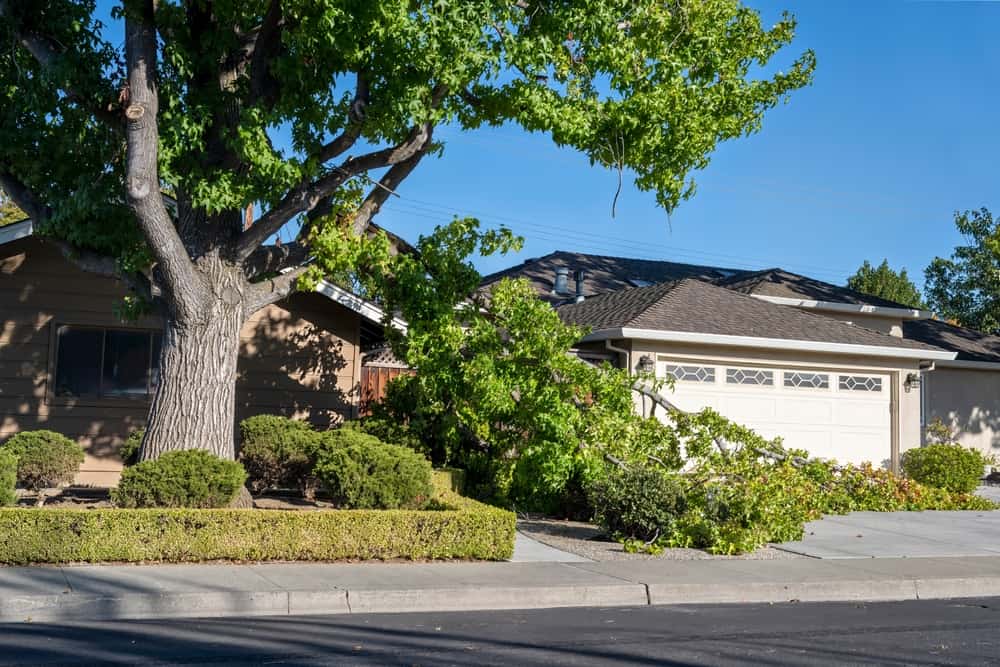
When a windstorm drops a tree onto your roof, your dwelling coverage — typically Coverage A on a standard HO-3 policy — kicks in for both the structural repair and the cost of removing the tree from your property. The same applies if a tree falls on a detached garage or a fence, which would fall under Coverage B, your other structures coverage. In those situations, most policies will cover tree removal up to $500 to $1,000 per tree, with the remainder of the damage repair covered up to your policy limits. Keep in mind your deductible applies here just like any other claim — if your deductible is $1,000 and total damage is $1,500, you’d receive $500 from your insurer.
What isn’t covered is where it gets frustrating. If a tree falls in your yard without hitting anything, most standard policies won’t pay for removal, even if the tree was brought down by a named storm. If the tree fell because it was already dead, rotting, or visibly diseased, your insurer may deny the claim entirely on the grounds that the damage was foreseeable and not sudden.
Flood and mudslide are excluded perils under most standard homeowners policies, which matters significantly in Suffolk County. After heavy rain or coastal storm surge — very real scenarios on Long Island’s South Shore — saturated soil can cause uprooting even from moderate winds. If your insurer determines that flooding or soil saturation caused the damage, that exclusion could apply.
There’s also the question of preventive removal. If you have a tree that’s leaning toward your house, clearly stressed after a nor’easter, and you want it taken down before it falls — your policy almost certainly won’t cover that. The logic insurers use is that removal of a living or standing tree, no matter how precarious, is a maintenance decision, not a covered loss.
One scenario that surprises people: if a tree falls and blocks your driveway or a ramp providing access to your home, some policies will cover removal even without structural damage — but this varies by insurer and policy language. It’s worth a direct call to your insurer to confirm before assuming either way.
Neighbor's Tree Fell on Your Property — Who Actually Pays?
This is one of the most common questions we hear from Suffolk County homeowners, and the answer tends to surprise people. If your neighbor’s tree falls on your house or garage during a storm, your own homeowners insurance is typically the policy that responds — not your neighbor’s. That feels counterintuitive, but it’s how liability works in most standard policies. The reasoning is that the storm caused the damage, not negligence on your neighbor’s part.
The exception is negligence. If your neighbor’s tree was visibly dead, rotting, or leaning dangerously, and you had previously notified them in writing about the hazard, you may have grounds to pursue their liability coverage for damages. But that requires documentation — ideally written communication before the tree fell, not a conversation you’re trying to reconstruct after the fact.
The reverse situation applies to you as well. If one of your trees falls on your neighbor’s property during a storm and the tree was healthy, their insurance typically handles it. But if that tree had been dead or clearly deteriorating, and they can show you knew about it, your liability exposure changes significantly.
This is one of the practical reasons why having a tree health assessment done on mature trees — especially in heavily wooded areas like Brookhaven, Smithtown, or Riverhead — isn’t just good maintenance. It’s documentation that protects you from liability claims down the road. Suffolk County’s housing stock skews older, with a lot of post-WWII neighborhoods where the trees planted alongside those homes are now 50 to 75 years old. Large, mature oaks and maples on residential lots are beautiful until they’re not. Knowing the health status of the trees on your property — and having that assessment on record — matters more than most homeowners realize until after something goes wrong.
Tree Removal Proof of Insurance: Why Your Contractor's Coverage Is Your Problem Too
Most homeowners searching this topic are focused on whether their own insurance will cover tree removal. That’s the right question — but there’s a second question that’s just as important and almost never comes up until it’s too late. The insurance status of the contractor you hire directly affects your liability as a homeowner.
If a tree service worker is injured on your property and the company doesn’t carry workers’ compensation insurance, you can be held personally liable for their medical bills, lost wages, and disability payments. Your homeowners policy won’t cover it. This isn’t a rare edge case — it’s a documented risk, and in New York State, where workers’ compensation rates for tree service businesses run higher than the national average, some smaller operators cut corners on coverage to reduce costs.
What Proof of Insurance Should You Ask a Tree Removal Company For?
Before any crew sets foot on your property, ask for a certificate of insurance — not just a verbal confirmation that they’re covered. A certificate of insurance is a one-page document issued by the contractor’s insurer that lists their coverage types, policy limits, and effective dates. It takes about 30 seconds to request and should be provided without hesitation by any legitimate tree service company.
At minimum, you’re looking for two types of coverage. General liability insurance covers property damage and third-party injuries — if a limb damages your roof or a neighbor’s fence during removal, this is what responds. Workers’ compensation insurance covers the crew members themselves if they’re injured on the job. Without both, you’re exposed.
It’s also worth asking whether the company is licensed to perform tree work in Suffolk County. Licensing requirements exist at both the state and municipal level in New York, and legitimate operators maintain current credentials. A company that hesitates on any of these questions — or offers to show you paperwork “later” — is a company worth walking away from, especially in the post-storm environment when storm-chasing contractors move quickly through affected areas.
We carry comprehensive liability insurance and workers’ compensation, and we provide proof of insurance before we begin any work. That’s not a selling point — it’s a baseline standard that every homeowner deserves from whoever they hire. We’re also Google Guaranteed, which means Google has independently verified our license and insurance as part of our Local Services Ads account. For homeowners who want a fast way to vet a contractor without making three phone calls, that badge is a meaningful signal.
Why Documenting Storm Damage Before Removal Can Make or Break Your Claim
Here’s something the insurance company pages don’t tell you clearly enough: the order of operations matters. If you remove a tree before documenting the damage and notifying your insurer, you may be handing them a reason to deny or reduce your claim. Adjusters need to assess the damage in its original state. Once the tree is gone and the debris is cleared, that window closes.
The practical sequence after a storm brings down a tree on an insured structure is this: photograph everything before anything is moved, including the point of impact, the root system or break point of the tree, and any structural damage it caused. Then call your insurance company to report the claim and ask about their adjuster timeline. Only after that conversation should you move forward with scheduling removal — unless there’s an immediate safety hazard, in which case document that urgency as well.
This is where working with an experienced local tree service makes a real difference. We provide documentation and detailed reports required for insurance claims, and in many cases we can complete that documentation while removal operations are underway, so safety and paperwork aren’t in conflict.
Suffolk County homeowners dealing with the aftermath of a nor’easter or tropical storm — the kind of systems that have historically hammered areas from Babylon through Brookhaven and out toward Riverhead — don’t have time to figure out the insurance claim process from scratch while a tree is sitting on their roof.
Long Island’s coastal geography creates conditions that accelerate tree failure in ways that aren’t always obvious. Sandy, waterlogged soils after heavy rain dramatically increase the chance of uprooting even from moderate winds. Trees that looked fine before a storm can come down not because of the wind alone, but because the ground couldn’t hold them. After events like Tropical Storm Isaias in 2020 or Hurricane Sandy in 2012, the volume of storm-related tree damage across Suffolk County was enormous — and the homeowners who fared best in the claims process were the ones who documented first and removed second.
What to Do After a Tree Falls on Your Suffolk County Property
The short version: document before you remove, verify your contractor’s insurance before they start, and understand that your policy covers damage to structures — not just the fact that a tree fell. Those three things alone will put you ahead of most homeowners navigating this for the first time.
Suffolk County’s combination of mature tree canopy, coastal storm exposure, and aging housing stock means this isn’t a hypothetical situation for most homeowners here — it’s a matter of when, not if. Knowing the rules before the next storm is a lot easier than trying to learn them after one.
If you’re dealing with storm damage now, or you want an honest assessment of the trees on your property before they become a problem, Miguels Tree Service is available 24/7 and offers free, no-obligation estimates. We’ve been working in Suffolk County for over 15 years, and we know what it takes to get the job done right — and documented correctly.