
Summary:
You searched “tree removal cost per foot” because you want a real number — not a range so wide it’s useless, and not a vague answer that ends with “call for a free estimate.” That’s a fair ask. The problem is that per-foot pricing is genuinely just a starting point. The final cost depends on several factors that vary from one Suffolk County property to the next, and no two jobs are exactly alike. This guide walks you through how per-foot pricing works, what pushes a quote up or down, and what to watch for so you can evaluate any estimate with confidence.
How Tree Removal Cost Per Foot Is Actually Calculated
The per-foot rate is based on a tree’s height, but height alone doesn’t determine what you’ll pay. Nationally, the typical range runs from $12 to $15 per linear foot for a straightforward removal — a tree with clear access, no structures nearby, and a manageable trunk. In Suffolk County, that baseline tends to run higher because of factors specific to this region: tighter residential lots, mature hardwood species, and the proximity of trees to houses, fences, and utility lines throughout towns like Huntington, Smithtown, and Brookhaven.
Think of per-foot pricing as the floor, not the ceiling. A 50-foot tree in an open backyard with easy equipment access is a very different job than a 50-foot tree leaning toward your roof with a power line running through its canopy. Same height, very different price.
What Size Ranges Actually Look Like in Real Dollars on Long Island
If you want a realistic sense of what tree removal costs in Suffolk County, here are the ranges that reflect Long Island pricing specifically. A 20-foot tree typically runs $290 to $550. A 30-foot tree falls in the $430 to $830 range. Move up to 40 feet and you’re looking at $580 to $1,110. At 50 feet, most jobs land somewhere between $720 and $1,390. The overall average for a tree removal in Suffolk County is around $1,400, with the full range spanning $500 to $2,300 depending on everything involved.
Those numbers are higher than what you’ll see on national cost guides, and that’s not an accident. Suffolk County’s housing stock is older, and the trees that came with those properties have had decades to grow into structures, fences, and utility lines. The lots in places like Port Jefferson Station, Nesconset, and Middle Island weren’t designed with crane access in mind. When a crew has to work around a detached garage, a vinyl fence, and a neighbor’s property line all at once, that complexity shows up in the quote.
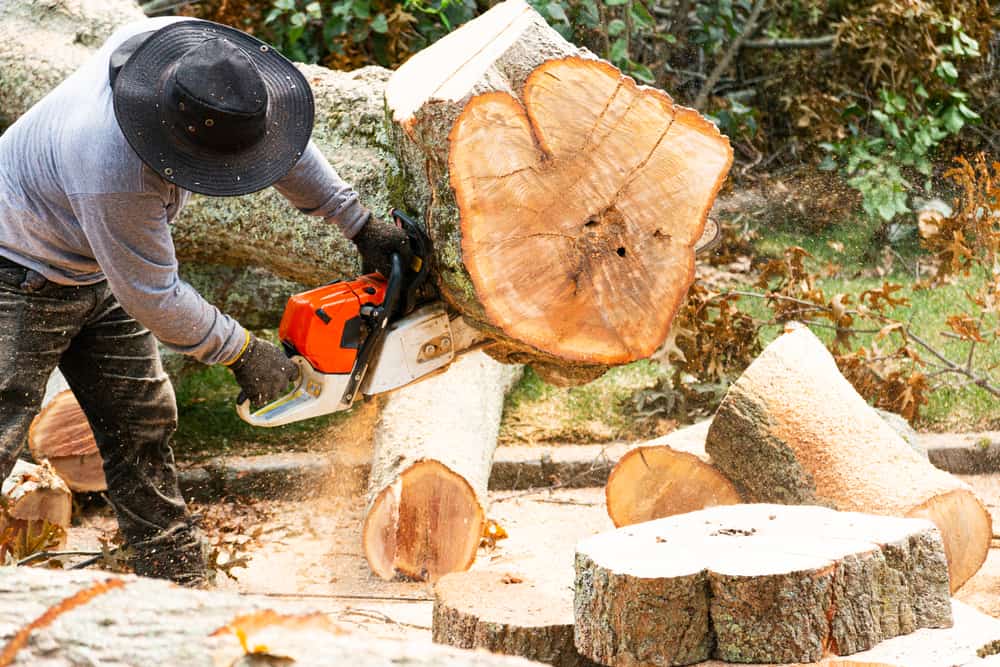
Trunk diameter matters just as much as height, and it’s often overlooked. A tree that’s 40 feet tall but has a 30-inch trunk at chest height requires significantly more cutting time and more powerful equipment than a slender tree of the same height. In challenging situations — trees with large trunks, difficult access, or proximity to structures — per-foot rates can reach $25 or more. That’s not price gouging; it’s the reality of what the job actually requires.
Species plays a role too. Red oak and white oak are the dominant hardwoods across much of Suffolk County, and they’re among the most labor-intensive trees to remove. The wood is dense, the trunks are often massive, and the canopy spread adds complexity to sectional removal. Eastern white pine is common as well — it grows tall (60 to 100 feet isn’t unusual on residential properties here), which means height alone drives the cost even when the trunk is manageable. Norway maple is frequently removed because of its invasive nature, and Bradford pear comes down often after storm damage because the species is structurally weak. Each of these trees has a different removal profile, and a professional assessment accounts for all of it.
Why Proximity to Structures Can Double Your Tree Removal Quote
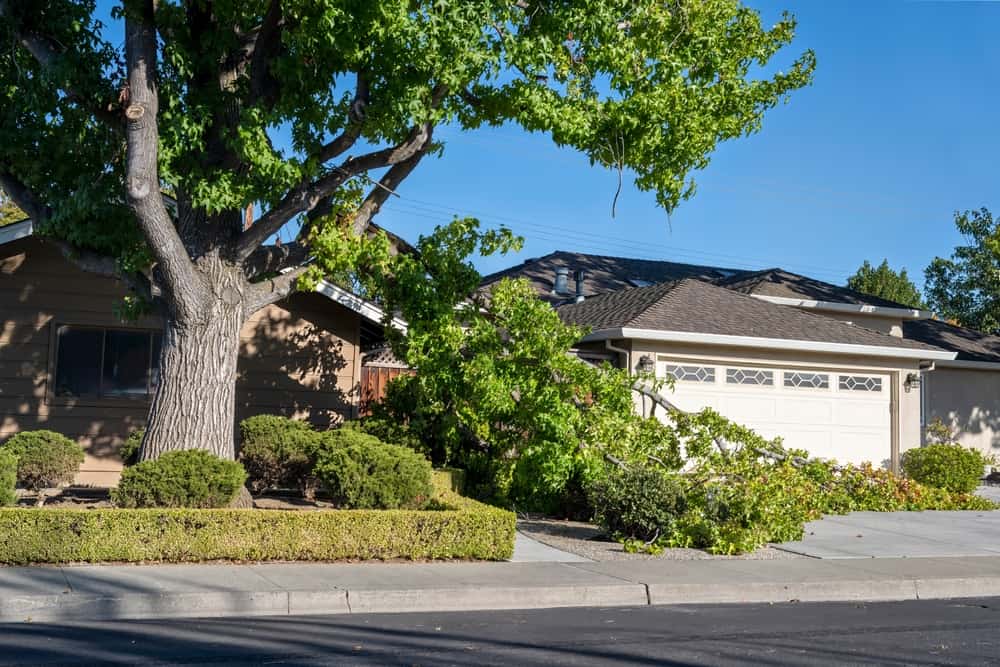
This is the factor that surprises homeowners most. A 30-foot tree in good condition with clear access might cost $500 to $800. That same tree leaning over your house, or tangled in power lines, could cost $1,200 to $1,800. The difference isn’t the tree — it’s the work required to bring it down safely without damaging anything around it.
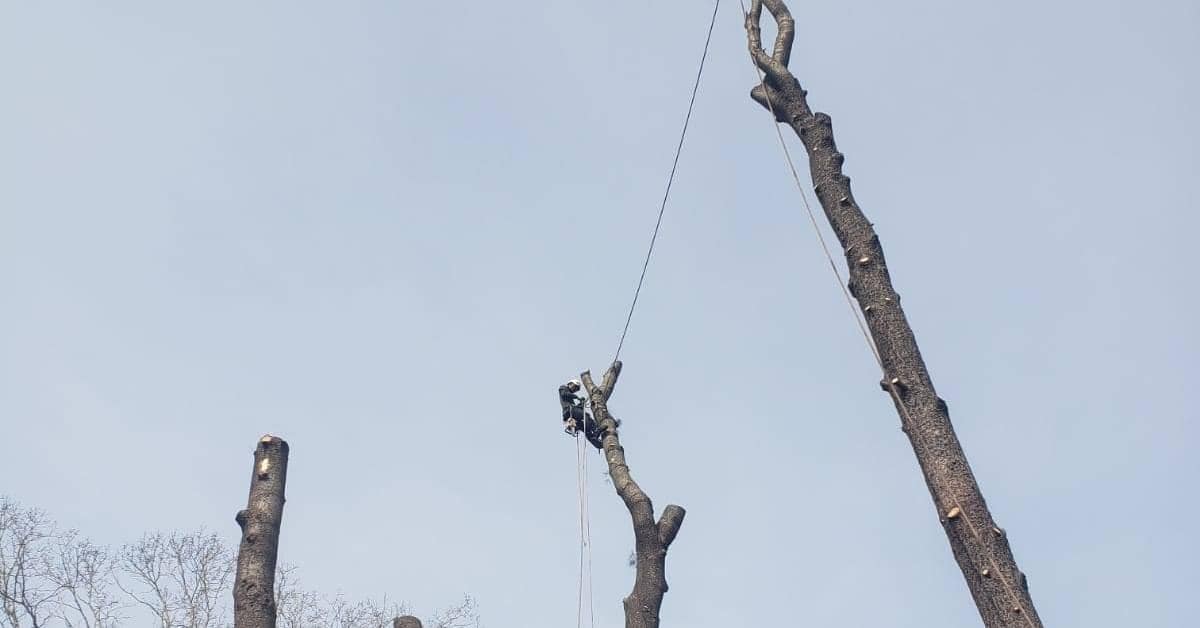
When a tree can’t be felled in one piece, we remove it in sections from the top down. That’s slower, more technical, and requires a climber or aerial equipment. In some cases — particularly with very large trees or extreme access constraints — a crane is the only safe option. Crane-assisted removal adds significant cost, but it’s sometimes the only way to protect your property. Trees over 80 feet often require cranes and specialized equipment, which puts the per-foot rate at $15 or more as a starting point before complexity is factored in.
Power lines are their own category. Utility companies are responsible for lines running from the street to the pole, but the line running from the pole to your house — the service drop — is generally the homeowner’s responsibility. If a tree is growing into or near that line, the removal requires coordination and extra care. Not every tree company is equipped or willing to work in that situation, and the ones that are will price the additional risk accordingly. It’s worth asking about this directly when you get a quote, because the answer tells you a lot about whether the company has actually assessed your specific job.
Emergency situations add another layer. If a tree has already come down or is actively threatening your home after a storm, emergency removal typically costs 1.5 to 3 times the standard rate. That premium reflects the urgency, the hazard, and the resources required to respond quickly. Suffolk County’s coastal exposure to nor’easters and summer storms means this scenario is more common here than in many other markets — it’s not unusual for a single storm to generate dozens of emergency calls across the county at once.
Dead Tree Removal Cost: Why It's Often More Than You'd Expect
A lot of homeowners assume that removing a dead tree should be cheaper — after all, it’s already gone. The reality is the opposite. Dead trees are structurally unpredictable in ways that living trees aren’t. The wood can be brittle, the root system may have already begun to fail, and the trunk can shatter during cutting rather than respond the way a healthy tree would. That unpredictability requires a more cautious, time-intensive approach — often sectional removal from the top down rather than a standard fell — which adds to the cost.
Suffolk County has been dealing with a wave of dead and compromised trees in residential neighborhoods, driven in part by the emerald ash borer, which has been active on Long Island for years. If you have ash trees on your property that are showing signs of decline — thinning canopy, dead branches, bark splitting — there’s a good chance they’re already compromised. Storm damage leaves its own legacy of standing dead trees throughout the county as well.
What's Actually Included in Your Tree Removal Quote
This is where a lot of quotes fall apart in comparison. Two companies can quote the same job at very different prices because they’re quoting different scopes of work — and if you don’t know what’s included, you can’t make a fair comparison.
Tree removal, at its most basic, means the tree comes down and the wood is cut into manageable pieces. What happens after that varies. Stump grinding is almost always a separate line item — most companies don’t include it in the base removal price unless you ask. Stump grinding typically runs $100 to $400 per stump depending on the size and root spread. If you skip it, you’re left with a stump that will eventually decay on its own but will take years to disappear and can attract insects in the meantime.
Debris hauling is another variable. Some companies include it, some charge extra, and some leave the wood on-site by default. If you want logs cut to firewood length, that’s often an add-on. If you want chips from the chipper, some companies will leave them as mulch at no charge. These details matter, and they should be spelled out in any written estimate before you agree to anything.
The cleanup question is one of the most common complaints in the tree service industry — not because companies do bad work, but because expectations weren’t set upfront. We walk you through exactly what the job includes before the crew shows up. If a quote doesn’t specify what happens to the debris, ask. If the answer is vague, that’s worth noting.
Getting at least three quotes from local companies is a reasonable approach, especially for larger jobs. But compare them on scope, not just price. A quote that’s $300 lower might not include stump grinding or debris removal — which means it’s actually more expensive once you add those in.
Tree Removal Cleanup in Suffolk County: What to Expect After the Job
Cleanup is a bigger deal in Suffolk County than many homeowners realize going in. The combination of mature trees, suburban lot sizes, and HOA expectations in communities throughout the county means that how a property looks after a removal is almost as important as the removal itself. A large oak can generate an enormous volume of debris — branches, bark, chips, and sections of trunk — and moving all of it takes real time and equipment.
A thorough cleanup should include hauling all debris off the property, raking or blowing the area around the work zone, and leaving the site in a condition you’d be comfortable with. If we use a wood chipper, the chips should either be removed or left in a designated spot you’ve agreed on. Logs from the trunk can sometimes be left for firewood if that’s what you want, but that’s a conversation to have before the job starts, not after.
Stump grinding, if included or added on, leaves behind a mix of wood chips and soil in the area where the stump was. Most homeowners fill that space with topsoil and seed it, or use the chips as mulch in a nearby bed. The grinding area should be reasonably level — not a perfect lawn, but not a hazard either.
For properties in HOA communities, which are common throughout Suffolk County, cleanup standards can be even more specific. Some HOAs require that all debris be removed within a certain timeframe, or that the property be restored to a particular condition before the job is considered complete. If you’re in an HOA, it’s worth checking your community’s guidelines before scheduling the work — and confirming with us that we’re aware of any specific requirements.
One more thing worth mentioning: permits. Many towns in Suffolk County require a permit before a tree above a certain size can be removed, and the rules vary between Brookhaven, Huntington, Smithtown, and other townships. Permit fees typically run $50 to $200, but failing to pull the required permit can result in fines up to $10,000. We know the requirements for your specific town and can help you navigate the process before the job starts.
Getting a Fair Tree Removal Quote in Suffolk County
Per-foot pricing is a useful starting point, but it’s only part of the picture. What you actually pay depends on the size and species of the tree, where it sits on your property, what’s nearby, and what the quote actually includes. In Suffolk County, those variables tend to push costs above national averages — and understanding why helps you evaluate any quote with confidence rather than guessing whether you’re being treated fairly.
The best protection against a bad experience is asking the right questions upfront: What’s included in the cleanup? Is stump grinding separate? Do I need a permit, and will you handle that? Is this price based on actually seeing the job? We answer those questions clearly and put it in writing.
If you’re dealing with a tree in Suffolk County — whether it’s a storm-damaged oak in Smithtown, a dead pine in Brookhaven, or a large tree that’s simply outgrown your yard — we’ve been handling jobs like yours for 15 years. Reach out for a free estimate and get a straight answer about what your specific job will cost.