Summary:
You’ve noticed something. A lean that wasn’t there before. A branch hanging at a wrong angle after last night’s wind. Maybe a crack running up the trunk you’ve been walking past for weeks telling yourself it’s probably fine.
The hard part isn’t the tree — it’s not knowing whether you’re overreacting or ignoring something serious. And with a roof over your family’s head, that’s not a comfortable place to sit.
This guide is written to help you think through it clearly. Just a straightforward look at what actually warrants an emergency call — and what can wait.
What Actually Counts as an Emergency Tree Situation
A true tree emergency is any situation where a tree or large limb poses an immediate, credible threat to a structure, a person, or a utility line — and where waiting even a day or two meaningfully increases that risk.
Not every storm-damaged tree is an emergency. Not every dead tree needs to come down this weekend. But some absolutely do, and the consequences of misjudging that are serious. We’ve been called to properties across Suffolk County where a homeowner waited too long, and the cost of that delay was measured in tens of thousands of dollars in structural damage.
The goal here is to help you tell the difference.
Warning Signs a Tree Needs Immediate Removal
The most important thing to understand is that dangerous trees don’t always look dangerous. A tree can be full, green, and leafy while its root system is quietly failing underground. That’s what makes this harder than it looks from the driveway.
That said, there are physical signs that should move any situation from “keep an eye on it” to “call today.” A sudden lean is the clearest one — not a tree that has always grown at an angle, but one that has shifted recently. That kind of movement almost always means root failure or structural damage at the base, and it doesn’t reverse itself. It progresses.
Cracks or splits in the main trunk, especially ones that run vertically or that you can see widening, are another serious signal. A tree with a split trunk is essentially two trees sharing a root system, and in a wind event, they pull in opposite directions. Large dead branches — what we call widow-makers — hanging in the canopy above a roof, driveway, or play area are a removal priority, not a trimming job.
Fungal growth at the base of the trunk, like mushrooms or shelf fungi, usually means internal decay that isn’t visible from the outside. Same goes for soft, spongy wood near the roots or a hollow sound when you knock on the lower trunk. If one-third or more of the interior of a tree is rotted out, the structural integrity is compromised regardless of how it looks from a distance.
Exposed or heaving roots are worth taking seriously too. When roots start lifting out of the ground, it typically means the tree is no longer anchored the way it should be — and that the next significant wind event could be the one that takes it down.
When a Storm Has Already Done the Damage — What to Do Next
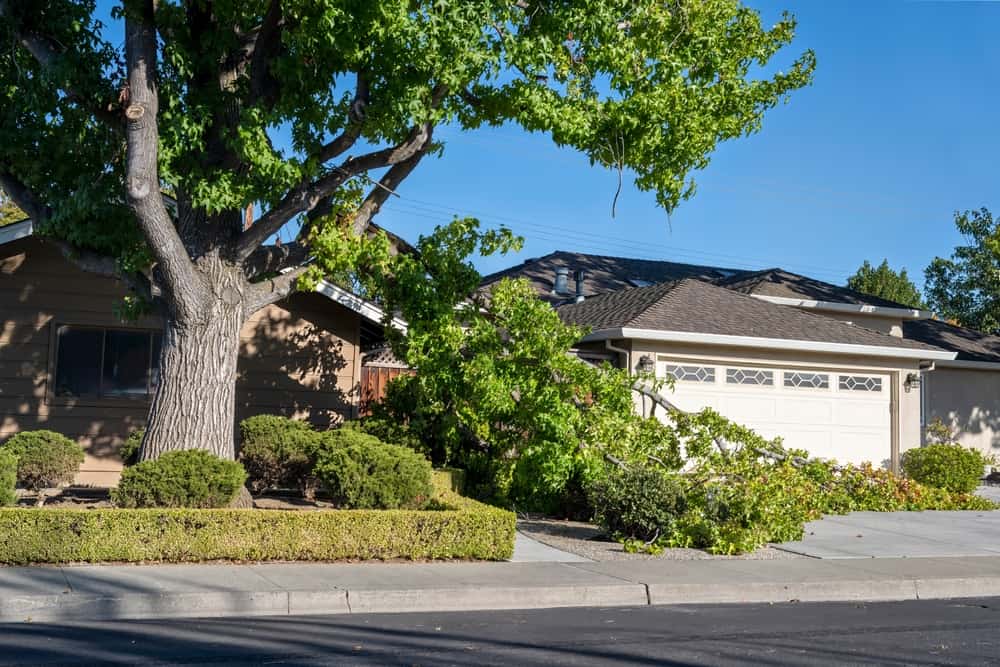
If a storm has already hit and you’re looking at a tree that’s partially down, leaning against your house, or sitting on your roof, the situation has moved past the warning stage. A few things matter a great deal right now.
First, don’t go near it. A tree that has partially fallen is under enormous tension. Limbs that look stable can shift without warning, especially as the wood dries and contracts or as the root ball continues to settle. If any part of the tree is in contact with a power line, treat the entire area as live and call PSEG Long Island before anyone — including a tree crew — gets close.
Second, document everything before any work begins. Photograph the damage from multiple angles, including the point of contact with any structure. Your homeowner’s insurance will likely cover removal costs if the tree has fallen on a covered structure, but the claim process goes much more smoothly when you have clear, timestamped photos taken before cleanup starts.
Third, be careful about who you call. After major storms, Long Island gets an influx of out-of-area contractors who show up door to door, offer fast quotes, and disappear once they’re paid. We’ve seen the aftermath of that work — improper cuts that leave dangerous stubs, debris left on the property, no insurance if something goes wrong. A tree service with a real local presence in Suffolk County or Nassau County, verifiable reviews, and a 631 area code is worth a short wait over a stranger who knocked on your door after a northeaster.
The goal after a storm isn’t just to get the tree off your property. It’s to do it safely, document it correctly, and leave your property in better shape than the storm left it.
Tree Removal on Long Island: What Makes This Market Different
Suffolk County and Nassau County aren’t generic suburbia. The combination of coastal storm exposure, aging housing stock, and specific tree species common to this area creates a risk profile that’s genuinely different from inland parts of New York.
The trees planted alongside the homes built in the 1950s and 1960s — the ones that defined neighborhoods in Smithtown, Huntington, Babylon, and across Nassau County — are now 60 to 70 years old. Many of them are reaching the end of their structural lifespan. That’s not an alarm, it’s just math. And it means that a hazard assessment that might have been optional ten years ago is worth doing now.
Why Long Island Trees Are Higher Risk Than You Might Think
The Emerald Ash Borer has been confirmed throughout Long Island, and it has quietly killed thousands of ash trees across both counties. A dead ash tree looks like a tree — until it doesn’t. They become brittle faster than most species, sometimes within one to three years of death, and they can fail with very little warning. If you have an ash tree on your property that has lost most of its leaves over the past couple of seasons, it warrants a close look from someone who knows what to look for.
Norway maples are another story specific to this area. They were planted widely in Suffolk County and Nassau County suburbs because they’re fast-growing and shade-tolerant, but they have shallow root systems that make them disproportionately vulnerable in wind events. A Norway maple that looks perfectly healthy in June can come down in a late-summer storm with little structural warning.
Then there’s the coastal factor. Homes on the South Shore facing the Atlantic, and communities along Long Island Sound on the North Shore, experience wind speeds that are meaningfully higher than what you’d see just twenty miles inland. That matters when you’re evaluating whether a tree with some structural compromise can handle another storm season. In many cases, the honest answer is no.
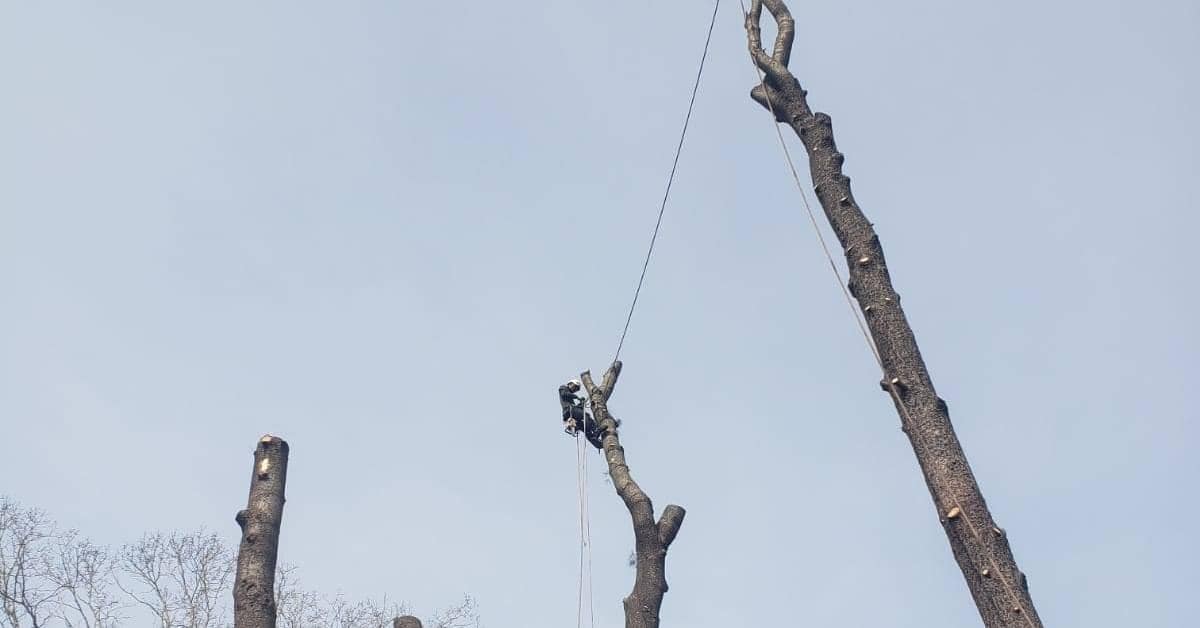
Nassau County adds another layer. In areas where homes sit twenty or thirty feet apart, a falling tree isn’t just your problem — it’s your neighbor’s problem too. That proximity raises the stakes on every hazard assessment and makes professional removal, with proper rigging and controlled lowering, the only responsible approach.
Frequently Asked Questions About Emergency Tree Removal in Suffolk County and Nassau County
One question we get constantly is whether homeowner’s insurance covers tree removal. The honest answer is: it depends on what happened. If a tree falls on your house, your fence, or another covered structure, most standard homeowner’s policies will cover the removal costs as part of the claim. But if you have a hazardous tree that hasn’t fallen yet — one that a certified arborist has flagged as a removal priority — insurance generally won’t cover that. You’re paying for that removal out of pocket either way. The difference is whether you do it on your schedule for a manageable cost, or after it lands on your roof for a much larger one.
Another question we hear a lot, especially after a storm, is how quickly we can actually get there. For genuine emergencies — a tree on a structure, a tree blocking access, anything involving a power line — we respond 24 hours a day, seven days a week across Suffolk County and Nassau County. We’re not dispatching from three counties away. For non-emergency situations, we typically get out for an assessment within a day or two and can give you a clear, written estimate before any work begins.
People also ask whether they need a permit to remove a tree in Suffolk County. In some municipalities, yes. Towns like Southampton and Huntington have tree preservation ordinances that require permits for removal of trees above a certain size. We know the local requirements and handle that process as part of the job — it’s not something you should have to figure out on your own.
And finally, the question nobody wants to ask but most people are thinking: how much does this cost? Tree removal in Suffolk County and Nassau County typically runs somewhere between $500 and $2,300 depending on the size of the tree, its location relative to structures, and whether crane access is needed. Emergency situations carry a premium over standard scheduled work, but the cost is almost never as high as people fear — and it’s almost always far less than the structural damage a fallen tree causes.
When to Call a Tree Service vs. When to Wait — The Bottom Line
If you’re reading this because something already happened — a storm, a crack you noticed, a branch that came down overnight — trust that instinct. The situations that turn into expensive emergencies almost always started with a homeowner who saw something, wasn’t sure, and decided to wait one more season.
You don’t have to make that call alone. A qualified arborist can look at a tree and give you a straight answer: this needs to come down, this can wait, or this just needs a trim. That assessment is worth a lot more than guessing from the driveway.
We’ve been doing this work across Suffolk County and Nassau County for 15 years. We’ve seen what Long Island storms do to trees, and we’ve seen what trees do to homes when nobody acts in time. If you’ve got a tree you’re not sure about, reach out — we’ll give you an honest answer, not just a sales pitch.