Summary:
If a tree just came through your roof, you’re probably not in the mood for a long article. So here’s the short version: don’t go back inside, and don’t call a tree company first. There’s a specific order to this, and skipping steps — even with the best intentions — can make things worse. It can complicate your insurance claim, expose you to structural risk you can’t see from the outside, or leave you vulnerable to contractors who show up fast for the wrong reasons. This page gives you the sequence, explains why it matters, and helps you move through a genuinely awful situation with a clear head.
Tree Fell on My House — What Do I Do First?
The first thing to do is get everyone out of the affected area. That means the room the tree hit, but also any adjacent rooms — because a tree on a roof can compromise load-bearing walls and structural supports without any visible signs from where you’re standing. The damage isn’t always obvious, and that’s exactly what makes it dangerous.
Once everyone is out and at a safe distance, look for two things before you do anything else: injuries and power lines. If anyone is hurt, or if you smell gas, call 911 immediately. If the tree brought down any electrical lines, treat every wire as live and stay at least 35 feet away — electricity can arc through wet ground well beyond the point of contact. Your next call in that scenario is to PSEG Long Island, the utility serving Suffolk County, before anyone — including a tree crew — gets near the site.
Is It Safe to Go Back Inside After a Tree Falls on Your House?
This is the question almost everyone asks first, and the honest answer is: not until a professional says it is. That’s not overcaution — it’s just how structural damage works. A large tree on a roof doesn’t just punch a hole through the shingles. It transfers enormous weight and lateral force to the framing beneath it, and the parts of the structure that absorb that load aren’t visible from the outside. A ceiling that looks intact from the hallway may be one small shift away from coming down.
Suffolk County’s housing stock is full of mature trees. The wooded neighborhoods along the North Shore — from Setauket and Port Jefferson through Huntington and Cold Spring Harbor — have some of the densest tree canopy on Long Island. Those are also the areas where older homes sit closest to large oaks and maples that have been growing for decades. When one of those trees comes down in a nor’easter or a fast-moving summer storm, the impact is significant.
The practical rule is this: retrieve medications, documents, or pets only if you can do so quickly from an unaffected part of the house, and only if there’s no structural concern in that area. Don’t go into the room where the tree landed. Don’t go into rooms directly beneath or adjacent to the impact zone. And don’t let anyone else go in either — not a neighbor trying to help, not a contractor who showed up at your door.
That last point matters more than most people expect. In the hours after a major storm in Suffolk County, door-to-door contractors appear quickly. Some are legitimate. Many are not. Storm chasers — out-of-area operators who move from market to market after weather events — target homeowners in exactly this moment, when you’re panicked, your property is exposed, and you feel pressure to act fast. They often lack proper insurance, charge inflated emergency rates, and may disappear before the job is done correctly. The right time to hire a tree company is after you’ve made the calls that actually need to come first.
Tree Fell in My Yard but Missed the House — Do I Still Need to Act Fast?
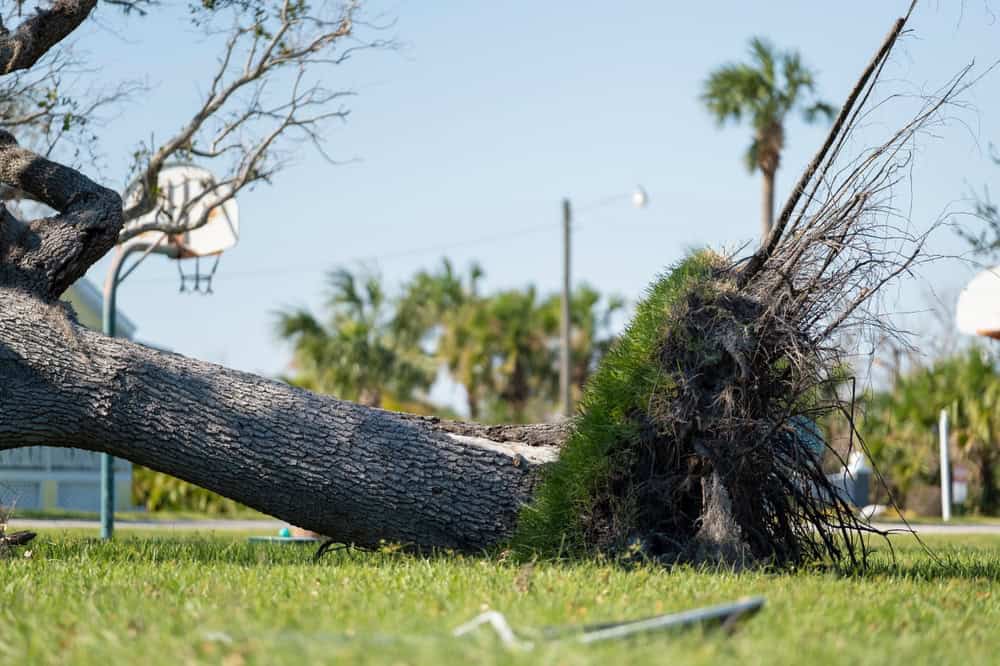
A tree that landed in your yard without hitting the house is a different situation, but it still deserves prompt attention. The urgency depends on where it fell and what it’s near. If it’s resting against your fence in an open area with no power lines involved, you have some breathing room. If it’s leaning against your house, your garage, a neighbor’s structure, or any utility line, treat it as an active hazard until a professional assesses it.
The root system of a fallen tree can shift. A tree that looks stable resting against a structure may continue moving as the soil settles or the wood dries and contracts. What looks contained today can cause secondary damage tomorrow, and that secondary damage may not be covered the same way by your insurance if there’s evidence you were aware of the hazard and didn’t act.
There’s also the question of access. A large tree in a yard can block doors, driveways, or emergency vehicle paths. In Suffolk County, where properties often have mature trees close to the house and limited side-yard clearance, a downed tree in the yard can create real access problems even when it didn’t hit anything. If the tree has made it impossible to safely exit your property, that changes the urgency level considerably.
The short version: if it missed the house and isn’t near any structure or utility line, you can take a breath and make your calls in order. If it’s leaning on anything, assume it’s unstable until someone with actual tree expertise tells you otherwise.
A Tree Fell on My House — Now What About Insurance?
Once safety is handled, your next call is to your insurance company — not the tree company. This is where most homeowners get the sequence wrong, and it’s the mistake that causes the most downstream frustration.
Your insurer needs to know about the damage before the tree is removed. In most cases, they’ll want documentation of the tree in place before any work begins. Removing it first — even with the best intentions — can complicate or delay your claim. Take photos and video from multiple angles before anything is touched, and do that even before you call your insurer.
Whose Insurance Pays When a Neighbor's Tree Falls on Your House?
This is one of the most common and most misunderstood questions in this entire situation. If your neighbor’s tree came through your roof, your instinct is probably to call them, demand their insurance handle it, or wait for someone to sort out who’s responsible. That instinct, while completely understandable, will slow everything down and may leave your house exposed to water damage while the conversation plays out.
In most cases, your own homeowners insurance is the primary payer — even when the tree belonged to your neighbor. Courts and insurance companies generally treat a storm-toppled tree as an act of nature, not negligence. That means the claim goes through your policy, not theirs.
The exception is when the tree owner knew in advance that the tree was dead, diseased, or structurally compromised and failed to do anything about it. If you had sent your neighbor a written notice about a visibly dead tree six months before it came through your roof, that’s a different conversation, and your attorney or insurer can advise you on it. But in the immediate aftermath of a storm, the practical answer is: file with your own insurer, document everything, and don’t wait for a liability dispute to resolve before protecting your property.
One more thing worth knowing: most standard homeowners policies cap tree removal reimbursement, often somewhere between $500 and $1,000 per tree. The structural repairs to your home are covered separately and typically at much higher limits. Understanding that distinction early helps you set realistic expectations about what your policy will and won’t cover for the removal itself.
How Long Can You Leave a Tree on Your Roof Before It Gets Worse?
Not long. The structural risk is one concern, but water is the other — and water moves fast. Once a tree has breached your roof, rain has a direct path into your attic, your insulation, your framing, and eventually your ceilings and walls. Secondary water damage can exceed the cost of the original tree damage if the roof stays open long enough.
Emergency tarping of a roof breach should happen within 24 to 48 hours of the impact. That window exists whether or not the tree has been removed yet — a tarp over the breach buys you time to get the adjuster out and the removal scheduled properly. We handle emergency tarping as part of our storm response, and it’s worth asking directly when you call any tree service.
The broader point is that “waiting to figure things out” has a real cost in this situation. Every hour the tree sits on a compromised roof is an hour the structure is under load it wasn’t designed to carry, and an hour the interior is exposed to whatever weather comes next. Suffolk County doesn’t give you much grace on that front — the 2023–2024 winter brought back-to-back nor’easters with wind gusts over 60 mph, and the county sits in the top ten most hurricane-vulnerable areas in the entire country. Storms here don’t wait for you to get organized.
This is also where the order of calls comes full circle. Once you’ve handled safety, notified your insurer, and documented the damage, calling a professional tree service isn’t just the next logical step — it’s the one that stops the clock on everything that’s getting worse while you wait.
What to Do After a Tree Falls on Your House in Suffolk County
The right order is: get everyone out, check for injuries and power lines, call 911 or PSEG Long Island if either is involved, document the damage, call your insurance company, and then call a tree service. That sequence protects your safety, your claim, and your home — in that order.
It sounds straightforward, but in the middle of a storm or right after one, it’s easy to skip steps or make calls out of order. Knowing the sequence ahead of time means you won’t have to figure it out under pressure.
If you’re dealing with this right now in Suffolk County and need a crew that’s been handling storm damage on Long Island for over 15 years — licensed, insured, and available around the clock — we’re ready to help. Call Miguels Tree Service and we’ll walk you through the next steps.