Summary:
You searched “tree removal cost” because you want a number. That’s fair. The problem is that most of what you’ll find online quotes a national average around $750 — and if you’ve already talked to a contractor in Suffolk County, NY, you know that number doesn’t mean much here. The local reality runs from $500 on the low end to well over $2,300, with most jobs landing somewhere around $1,400. That’s not price gouging. There are real reasons for it. This guide explains what drives tree removal pricing in Suffolk County, what a fair quote looks like, and a few things that catch homeowners off guard when the final bill arrives.
Average Tree Removal Cost in Suffolk County, NY
The national average for tree removal sits around $750, but Suffolk County, NY is not an average market. Higher labor costs, denser suburban lots, more complex permit requirements, and a landscape full of mature hardwoods — white oaks, red oaks, pin oaks — all push prices higher than what you’d pay in most other parts of the country. That’s not a complaint. It’s just the reality of where we live.
For most residential jobs in Suffolk County, you’re looking at somewhere between $500 and $2,300, with the average coming in around $1,400. A small tree under 30 feet on an open lot is toward the bottom of that range. A large oak close to your house or near a utility line is toward the top — or above it.
Average Cost to Cut Down a 30-Foot Tree on Long Island
A 30-foot tree — think a younger maple, a small ornamental, or a pine that hasn’t fully matured — is the most straightforward removal job in most cases. In Suffolk County, NY, a tree at this height typically runs between $400 and $700 when conditions are favorable: open access, no structures nearby, no permit complications.
That said, “30 feet” doesn’t tell the whole story. A 30-foot silver maple with a trunk that’s spread wide over three decades is a different job than a 30-foot sapling. Trunk diameter matters because it affects how long the crew is on-site and what equipment we need. Species matters too — hardwoods like oaks are denser and more labor-intensive to cut through than softwoods like pines.
Location on the property is often the biggest variable at this size. A small tree sitting in the middle of a backyard with clear access is quick work. That same tree wedged between your fence, your deck, and your neighbor’s property line changes the job entirely. Rigging, careful directional cutting, and slower removal add time and cost.
One more thing worth knowing at this size: dead trees are not automatically cheaper. A dead or decaying tree is structurally unpredictable. We can’t rely on the wood behaving the way live wood does, which means more precautions, more time, and sometimes more equipment. If you have a dead tree you’ve been watching for a while, don’t assume the quote will be at the low end of the range.
Average Price to Cut Down a 40-Foot Tree in Suffolk County
At 40 feet, you’re getting into the range where most mature suburban trees on Long Island actually live. The post-WWII development that shaped much of Suffolk County planted a lot of trees that are now 60 to 80 years old — and many of them are right around this height or taller. These are the oaks and maples in backyards across Smithtown, Huntington, Islip, and Brookhaven that homeowners are now dealing with as they age, lean, or start dropping large limbs.
For a 40-foot tree in a standard residential setting in Suffolk County, expect to pay somewhere between $600 and $1,200. Where you land in that range depends on the same factors as smaller trees — species, trunk diameter, access, proximity to structures — but at this height, those variables carry more weight. A 40-foot red oak close to a deck or fence isn’t just a bigger version of the 30-foot job. It requires more deliberate rigging, more precise cutting sequences, and more time.
Trees near power lines are a separate category entirely. PSEG Long Island and LIPA have their own protocols for work near utility lines, and removal in those situations can push costs significantly higher — sometimes well past the standard residential range.
If your tree is close to the house, near a fence line, or in a tight backyard with limited equipment access, mention that when you call for an estimate. It’s not a reason to avoid getting the work done — it’s just information that helps us give you an accurate number rather than a low quote that climbs once we see the job in person.
What Should Be Included in Your Tree Removal Quote
One of the most common reasons homeowners feel surprised by tree removal costs isn’t the base price — it’s what wasn’t in the original quote. Two companies can quote the same tree at very different numbers, and sometimes the lower one is lower because it’s missing things the higher one includes.
Before you sign anything, make sure you know exactly what’s covered. Labor and equipment should always be included. Debris removal — hauling away the wood, branches, and brush — should be explicitly stated. And stump grinding is almost never included in a standard tree removal quote. It’s a separate service, and in Suffolk County, it typically adds $150 to $400 depending on the stump size and root complexity.
Do You Need a Permit to Remove a Tree in Suffolk County, NY?
This is where a lot of Suffolk County, NY homeowners get caught off guard. The short answer is: it depends on your township, and the rules vary more than most people realize.
Suffolk County is made up of ten townships — Babylon, Brookhaven, East Hampton, Huntington, Islip, Riverhead, Shelter Island, Smithtown, Southampton, and Southold — and each one has its own tree ordinance. What requires a permit in Huntington may not require one in Smithtown, and the fees, timelines, and protected species lists differ across all of them. Permit fees for noncommercial properties typically run around $25, while commercial properties are closer to $150, but that varies by municipality too.
What doesn’t vary is the consequence of skipping the permit when one is required. Violations can result in fines up to $10,000. A standard permit application in most Suffolk County, NY townships takes 10 to 20 days to process, though emergency permits for genuinely hazardous situations can sometimes be issued faster.
We’ll pull the permit for you as part of the job. It’s worth asking upfront whether that’s included in your quote and who’s responsible for the filing. If a contractor tells you a permit isn’t necessary without actually checking your specific township’s rules, that’s worth a follow-up question. The rules are local, and they matter.
Why Emergency Tree Removal Costs More — and When It's Worth It
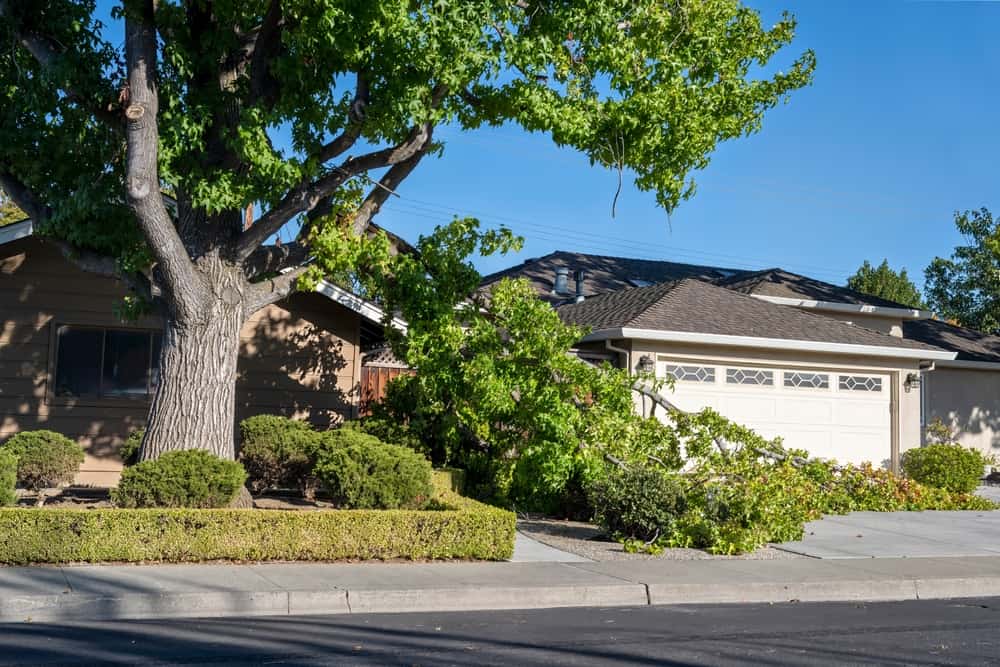
Suffolk County, NY’s coastal geography puts it directly in the path of nor’easters, tropical storms, and the kind of sustained wind events that bring large branches — and sometimes entire trees — down on houses, fences, and driveways. The October 2025 nor’easter alone triggered a state of emergency across the county, with widespread tree damage from one end of Long Island to the other.
When a tree comes down in a storm or is actively threatening your home, the pricing math changes. Emergency tree removal typically runs 1.5 to 2 times the standard rate for the same job. A medium tree that would cost $400 to $1,200 under normal circumstances can run $800 to $1,800 when it needs to come down immediately. Large trees in emergency situations can push $1,500 to $3,000 or more.
That premium exists for real reasons. Our emergency crews are mobilized outside of normal business hours, often in difficult weather conditions, with no advance planning time. Equipment has to be dispatched quickly. The work itself is more dangerous because storm-damaged trees are structurally compromised in ways that aren’t always obvious until you’re in the middle of the job.
The honest advice here is to address trees you’re already concerned about before a storm forces the issue. If you have a large oak that’s been leaning toward the house, or a dead tree that’s been dropping limbs, getting it removed on your schedule — ideally in late fall or winter when demand is lower and prices tend to soften — is almost always less expensive than calling us at 11pm after it comes down. We offer 24/7 emergency response because sometimes there’s no choice, but the best emergency is the one you prevent.
Will homeowners insurance cover it? Only after a covered loss event — meaning the tree has to actually damage an insured structure for a claim to apply. Preventative removal is almost always out of pocket, regardless of how obvious the hazard is.
Getting a Fair Tree Removal Quote in Suffolk County, NY
The biggest takeaway here is that tree removal pricing in Suffolk County, NY is genuinely variable — and that’s not a red flag, it’s just the nature of the work. Height, species, trunk size, access, proximity to structures, permit requirements, and whether stump grinding is included all factor into what a job actually costs. A quote that looks low on the surface may not include everything a higher quote does.
What you’re looking for is a contractor who shows up, looks at the actual tree, and gives you a written number that accounts for all of it — not a ballpark over the phone. Licensed, insured, with workers’ compensation coverage. Those aren’t nice-to-haves; they protect you if something goes wrong on your property.
We’ve been doing this work in Suffolk County for 15 years. We offer free on-site estimates, same or next-day consultations, and we’ll give you a clear breakdown before anything gets scheduled. Call us for a straight answer on what your specific job will cost.